Showing posts with label Wind pattern changes. Show all posts

How will wind-generated marine aerosols amplify or reduce global warming? Marine clouds are sensitive to surface wind speed by Paul Glantz

Insight: marine clouds are sensitive to surface wind speed

Greenhouse gases affect Earth's climate but aerosol particles are also important for our planet's radiation budget. This is because these particles directly scatter solar radiation back into space or absorb it, and indirectly influence the properties of clouds by acting as cloud-condensation nuclei. When predicting how the climate will respond to an enhanced greenhouse effect, a big challenge is also to figure out how wind-generated marine aerosols will amplify or reduce global warming. The outcome is uncertain because of surface wind-speed predictions.
by Paul Glantz, environmentalresearchweb.org, September 27, 2010
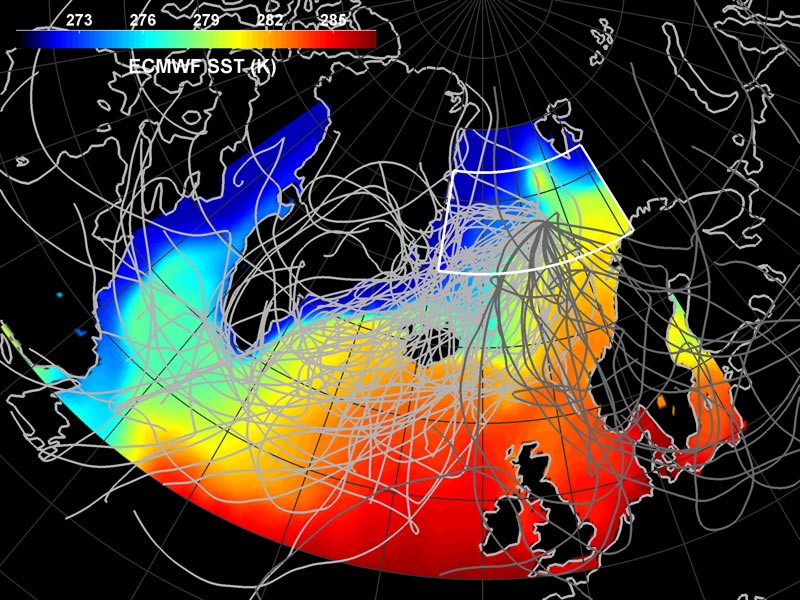
We can investigate marine clouds using satellite observations. Figure 1 shows the correlation between satellite cloud optical thickness (COT) and model surface wind speed (U10m), obtained in the sub-arctic marine atmosphere over the Norwegian Sea and Barents Sea (this area is shown in figure 2). The movement of marine air masses, before they arrive in the area being investigated, are represented by the light solid lines in figure 2. The relationship shown in figure 1 allows a very simple but powerful way to incorporate climate forcing in model predictions, and highlight how marine sea-spray influences COT and the way that it affects the global climate.
We will evaluate results from these optical property measurements on low-level clouds, as well as on estimated cloud-droplet numbers, based on model simulations. To this end, a process model will be developed that can accurately handle both predictions of vertical mixing of water vapour and clouds, together with the number of sea-salt particles – which are greatly affected by wind speeds – and descriptions of gas-phase chemistry and aerosol-cloud interactions.

About the author

Paul Glantz is an associate research scientist at the Department of Applied Environment Science at Stockholm University, Sweden. His work focuses on understanding aerosol cloud interactions in the lower background atmosphere and in anthropogenic-influenced air masses.

J Turner et al. GRL 36; Non‐annular atmospheric circulation change induced by stratospheric ozone depletion: Antarctic sea ice extent increase role

Geophysical Research Letters, 36, L08502; doi:10.1029/2009GL037524.

Non‐annular atmospheric circulation change induced by stratospheric ozone depletion and its role in the recent increase of Antarctic sea ice extent

John Turner (British Antarctic Survey, National Environment Research Council, Cambridge, U.K.), Josefino C. Comiso (NASA Goddard Space Flight Center, Greenbelt, MD, U.S.A.), Gareth J. Marshall, Tom A. Lachlan‐Cope, Tom Bracegirdle, Ted Maksym, Michael P. Meredith, Zhaomin Wang, and Andrew Orr (British Antarctic Survey, National Environment Research Council, Cambridge, U.K.)

Abstract

Based on a new analysis of passive microwave satellite data, we demonstrate that the annual mean extent of Antarctic sea ice has increased at a statistically significant rate of 0.97% dec−1 since the late 1970s. The largest increase has been in autumn when there has been a dipole of significant positive and negative trends in the Ross and Amundsen‐Bellingshausen Seas respectively. The autumn increase in the Ross Sea sector is primarily a result of stronger cyclonic atmospheric flow over the Amundsen Sea. Model experiments suggest that the trend towards stronger cyclonic circulation is mainly a result of stratospheric ozone depletion, which has strengthened autumn wind speeds around the continent, deepening the Amundsen Sea Low through flow separation around the high coastal orography. However, statistics derived from a climate model control run suggest that the observed sea ice increase might still be within the range of natural climate variability.

(Received 29 January 2009, accepted 25 March 2009, published 23 April 2009.)

Turner, J., J. C. Comiso, G. J. Marshall, T. A. Lachlan‐Cope, T. Bracegirdle, T. Maksym, M. P. Meredith, Z. Wang, & A. Orr (2009), Non‐annular atmospheric circulation change induced by stratospheric ozone depletion and its role in the recent increase of Antarctic sea ice extent, Geophysical Research Letters, 36, L08502; doi:10.1029/2009GL037524.

Link to abstract: http://www.agu.org/pubs/crossref/2009/2009GL037524.shtml

C. L. Archer & K. Caldeira, GRL, 35 (2008), Historical trends in the jet streams

Geophysical Research Letters, 35 (2008) L08803; doi:10.1029/2008GL033614.

Historical trends in the jet streams

Cristina L. Archer and Ken Caldeira (Department of Global Ecology, Carnegie Institution of Washington, Stanford, CA, U.S.A.)

(Received 12 February 2008, revised 10 March 2008, accepted 14 March 2008, published 18 April 2008.)

Abstract

Jet streams, the meandering bands of fast winds located near the tropopause, are driving factors for weather in the midlatitudes. This is the first study to analyze historical trends of jet stream properties based on the ERA-40 and the NCEP/NCAR reanalysis datasets for the period 1979 to 2001. We defined jet stream properties based on mass and mass-flux weighted averages. We found that, in general, the jet streams have risen in altitude and moved poleward in both hemispheres. In the northern hemisphere, the jet stream weakened. In the southern hemisphere, the sub-tropical jet weakened, whereas the polar jet strengthened. Exceptions to this general behavior were found locally and seasonally. Further observations and analysis are needed to confidently attribute the causes of these changes to anthropogenic climate change, natural variability, or some combination of the two.


C. Archer & K. Caldeira: Jet streams are shifting and may be shifting paths of storms and hurricanes polewards

Jet streams are shifting and may alter paths of storms and hurricanes

Storm paths in North America are likely to shift northward as a result of the jet stream changes. Hurricanes, whose development tends to be inhibited by jet streams, may become more powerful and more frequent as the jet streams move away from the sub-tropical zones where hurricanes are born.

ScienceDaily (April 17, 2008) — The Earth's jet streams, the high-altitude bands of fast winds that strongly influence the paths of storms and other weather systems, are shifting--possibly in response to global warming. Scientists at the Carnegie Institution determined that over a 23-year span from 1979 to 2001 the jet streams in both hemispheres have risen in altitude and shifted toward the poles. The jet stream in the northern hemisphere has also weakened. These changes fit the predictions of global warming models and have implications for the frequency and intensity of future storms, including hurricanes.

Cristina Archer and Ken Caldeira of the Carnegie Institution's Department of Global Ecology tracked changes in the average position and strength of jet streams using records compiled by the European Centre for Medium-Range Weather Forecasts, the National Centers for Environmental Protection, and the National Center for Atmospheric Research. The data included outputs from weather prediction models, conventional observations from weather balloons and surface instruments, and remote observations from satellites.

Jet streams twist and turn in a wide swath that changes from day to day. The poleward shift in their average location discovered by the researchers is small, about 19 kilometers (12 miles) per decade in the northern hemisphere, but if the trend continues the impact could be significant. "The jet streams are the driving factor for weather in half of the globe," says Archer. "So, as you can imagine, changes in the jets have the potential to affect large populations and major climate systems."

Storm paths in North America are likely to shift northward as a result of the jet stream changes. Hurricanes, whose development tends to be inhibited by jet streams, may become more powerful and more frequent as the jet streams move away from the sub-tropical zones where hurricanes are born.

The observed changes are consistent with numerous other signals of global warming found in previous studies, such as the widening of the tropical belt, the cooling of the stratosphere, and the poleward shift of storm tracks. This is the first study to use observation-based datasets to examine trends in all the jet stream parameters, however.

"At this point we can't say for sure that this is the result of global warming, but I think it is," says Caldeira. "I would bet that the trend in the jet streams' positions will continue. It is something I'd put my money on."

The results are published in the April 18, 2008, Geophysical Research Letters.

Link to article: http://www.sciencedaily.com/releases/2008/04/080416153558.htm

R. F. Anderson et al., Science, Vol. 323, No. 5920: Wind-driven upwelling in the Southern Ocean and the deglacial rise in atmospheric CO2

Science (13 March 2009), Vol. 323, No. 5920, pp. 1443-1448; DOI: 10.1126/science.1167441


Research Articles

Wind-driven upwelling in the Southern Ocean and the deglacial rise in atmospheric CO2

R. F. Anderson,1,2* S. Ali,1,2 L. I. Bradtmiller,1,2{dagger} S. H. H. Nielsen,3 M. Q. Fleisher,1 B. E. Anderson,1 and L. H. Burckle1

Abstract

Wind-driven upwelling in the ocean around Antarctica helps regulate the exchange of carbon dioxide (CO2) between the deep sea and the atmosphere, as well as the supply of dissolved silicon to the euphotic zone of the Southern Ocean. Diatom productivity south of the Antarctic Polar Front and the subsequent burial of biogenic opal in underlying sediments are limited by this silicon supply. We show that opal burial rates, and thus upwelling, were enhanced during the termination of the last ice age in each sector of the Southern Ocean. In the record with the greatest temporal resolution, we find evidence for two intervals of enhanced upwelling concurrent with the two intervals of rising atmospheric CO2 during deglaciation. These results directly link increased ventilation of deep water to the deglacial rise in atmospheric CO2.

1 Lamont-Doherty Earth Observatory of Columbia University, Post Office Box 1000, Palisades, NY 10964, USA.
2 Department of Earth and Environmental Sciences, Columbia University, New York, NY 10027, USA.
3 Antarctic Marine Geological Research Facility, Florida State University, Tallahassee, FL 32306, USA.

{dagger} Present address: Department of Marine Chemistry and Geochemistry, Woods Hole Oceanographic Institution, Woods Hole, MA 02543, USA.

*Correspondence. e-mail: boba@ldeo.columbia.edu

Read the Full Text


Link to this abstract: http://www.sciencemag.org/cgi/content/abstract/323/5920/1443

Robert Anderson et al., Science, Wind shifts may stir CO2 from Antarctic depths

Wind shifts may stir CO2 from Antarctic depths

environmentalresearchweb.org, March 20, 2009

Releases may have speeded end of last ice age, and could act again.

Natural releases of carbon dioxide from the Southern Ocean due to shifting wind patterns could have amplified global warming at the end of the last ice age – and could be repeated as manmade warming proceeds, a new paper in the journal Science suggests.

Many scientists think that the end of the last ice age was triggered by a change in Earth's orbit that caused the northern part of the planet to warm. This partial climate shift was accompanied by rising levels of the greenhouse gas CO2, ice core records show, which could have intensified the warming around the globe. A team of scientists at Columbia University's Lamont-Doherty Earth Observatory now offers one explanation for the mysterious rise in CO2: the orbital shift triggered a southward displacement in westerly winds, which caused heavy mixing in the Southern Ocean around Antarctica, pumping dissolved carbon dioxide from the water into the air.

"The faster the ocean turns over, the more deep water rises to the surface to release CO2," said lead author Robert Anderson, a geochemist at Lamont-Doherty. "It's this rate of overturning that regulates CO2 in the atmosphere." In the last 40 years, the winds have shifted south much as they did 17,000 years ago, said Anderson. If they end up venting more CO2 into the air, manmade warming underway now could be intensified.

Scientists have been studying the oceans for more than 25 years to understand their influence on CO2 levels and the glacial cycles that have periodically heated and chilled the planet for more than 600,000 years. Ice cores show that the ends of other ice ages also were marked by rises in CO2.

Two years ago, J.R. Toggweiler, a scientist at the National Oceanic and Atmospheric Administration (NOAA), proposed that westerly winds in the Southern Ocean around Antarctica may have undergone a major shift at the end of the last ice age. This shift would have raised more CO2-rich deep water to the surface, and thus amplified warming already taking place due to the earth's new orbital position. Anderson and his colleagues are the first to test that theory by studying sediments from the bottom of the Southern Ocean to measure the rate of overturning.

The scientists say that changes in the westerlies may have been triggered by two competing events in the northern hemisphere about 17,000 years ago. The Earth's orbit shifted, causing more sunlight to fall in the north, partially melting the ice sheets that then covered parts of the United States, Canada and Europe. Paradoxically, the melting may also have spurred sea-ice formation in the North Atlantic Ocean, creating a cooling effect there. Both events would have caused the westerly winds to shift south, toward the Southern Ocean. The winds simultaneously warmed Antarctica and stirred the waters around it. The resulting upwelling of CO2 would have caused the entire globe to heat.

Anderson and his colleagues measured the rate of upwelling by analysing sediment cores from the Southern Ocean. When deep water is vented, it brings not only CO2 to the surface but nutrients. Phytoplankton consume the extra nutrients and multiply.

In the cores, Anderson and his colleagues say spikes in plankton growth between roughly 17,000 years ago and 10,000 years ago indicate added upwelling. By comparing those spikes with ice core records, the scientists realized the added upwelling coincided with hotter temperatures in Antarctica as well as rising CO2 levels.

In the same issue of Science, Toggweiler writes a column commenting on the work. "Now I think this really starts to lock up how the CO2 changed globally," he said in an interview. "Here's a mechanism that can explain the warming of Antarctica and the rise in CO2. It's being forced by the north, via this change in the winds."

At least one model supports the evidence. Richard Matear, a researcher at Australia's Commonwealth Scientific and Industrial Research Organisation, describes a scenario in which winds shift south and produce an increase in CO2 venting in the Southern Ocean. Plants, which incorporate CO2 during photosynthesis, are unable to absorb all the added nutrients, causing atmospheric CO2 to rise.

Some other climate models disagree. In those used by the Intergovernmental Panel on Climate Change, the westerly winds do not simply shift north-south. "It's more complicated than this," said Axel Timmermann, a climate modeler at the University of Hawaii. Even if the winds did shift south, Timmermann argues, upwelling in the Southern Ocean would not have raised CO2 levels in the air. Instead, he says, the intensification of the westerlies would have increased upwelling and plant growth in the Southeastern Pacific, and this would have absorbed enough atmospheric CO2 to compensate for the added upwelling in the Southern Ocean.

"Differences among model results illustrate a critical need for further research," said Anderson. These, include "measurements that document the ongoing physical and biogeochemical changes in the Southern Ocean, and improvements in the models used to simulate these processes and project their impact on atmospheric CO2 levels over the next century."

Anderson says that if his theory is correct, the impact of upwelling "will be dwarfed by the accelerating rate at which humans are burning fossil fuels." But, he said, "It could well be large enough to offset some of the mitigation strategies that are being proposed to counteract rising CO2, so it should not be neglected."

In addition to Anderson, the paper was coauthored by Simon Nielsen of Florida State University, and five Lamont-Doherty researchers: Shahla Ali, Louisa Bradtmiller, Martin Fleisher, Brenton Anderson and Lloyd Burckle. The study was funded by NOAA, the National Science Foundation, Norwegian Research Council and Norwegian Polar Institute.

Source: columbia

Link to article: http://environmentalresearchweb.org/cws/article/yournews/38319