Showing posts with label terra preta. Show all posts

El Dorado Located


As I have posted on extensively, the creation of terra preta soils permitted dense urbanized Stone Age populations.  Present day clearing activity is now exposing their presence for the archeological record.


It is noteworthy that these cities show dates only as early as 200 AD.  This is likely a result of limited sampling.  The tool set necessary was already a couple of thousand years old.  This is common though for such dating because most samples come from areas representing the maximization of the culture and likely miss the long early development.


The late dates support the idea that the whole society was extent when the new world was discovered.  Once again Europeans did not so much as miss these antique civilizations so much as their pathogens got there first and threw these societies down.  The nastiest pathogen was the slave trade of course.


With out question, these were states and they certainly fit the story of El Dorado.  They most likely decorated buildings with gold and this enhanced the story.  We are not seeing stone structures but we did not see them in Mesopotamia either.  We have mounds and these were certain to hold wood frame structures of the leaders.


Terra preta made possible an Amazonian population in the tens of millions.  The culture itself most likely prevented it from happening except for locales like this.


Amazon explorers uncover signs of a real El Dorado


Satellite technology detects giant mounds over 155 miles, pointing to sophisticated pre-Columbian culture


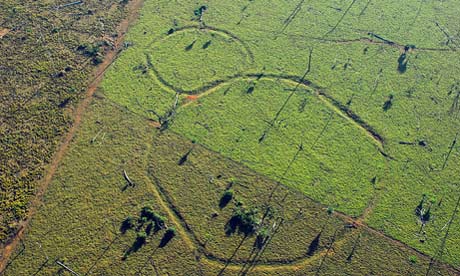
An aerial picture of traces of earthworks built by a lost Amazonian civilisation dating to 200AD. Photograph: National Geographic
It is the legend that drew legions of explorers and adventurers to their deaths: an ancient empire of citadels and treasure hidden deep in theAmazon jungle.
Spanish conquistadores ventured into the rainforest seeking fortune, followed over the centuries by others convinced they would find a lost civilisation to rival the Aztecs and Incas.
Some seekers called it El Dorado, others the City of Z. But the jungle swallowed them and nothing was found, prompting the rest of the world to call it a myth. The Amazon was too inhospitable, said 20th century scholars, to permit large human settlements.
Now, however, the doomed dreamers have been proved right: there was a great civilisation. New satellite imagery and fly-overs have revealed more than 200 huge geometric earthworks carved in the upper Amazon basin near Brazil's border with Bolivia.

Spanning 155 miles, the circles, squares and other geometric shapes form a network of avenues, ditches and enclosures built long before Christopher Columbus set foot in the new world. Some date to as early as 200 AD, others to 1283.
Scientists who have mapped the earthworks believe there may be another 2,000 structures beneath the jungle canopy, vestiges of vanished societies.
The structures, many of which have been revealed by the clearance of forest for agriculture, point to a "sophisticated pre-Columbian monument-building society", says the journal Antiquity, which has published the research.

The article adds: "This hitherto unknown people constructed earthworks of precise geometric plan connected by straight orthogonal roads. The 'geoglyph culture' stretches over a region more than 250km across, and exploits both the floodplains and the uplands … we have so far seen no more than a tenth of it."
The structures were created by a network of trenches about 36ft (nearly 11 metres) wide and several feet deep, lined by banks up to 3ft high. Some were ringed by low mounds containing ceramics, charcoal and stone tools. It is thought they were used for fortifications, homes and ceremonies, and could have maintained a population of 60,000 – more people than in many medieval European cities.
The discoveries have demolished ideas that soils in the upper Amazon were too poor to support extensive agriculture, says Denise Schaan, a co-author of the study and anthropologist at the Federal University of Pará, in Belém, Brazil. She told National Geographic: "We found this picture is wrong. And there is a lot more to discover in these places, it's never-ending. Every week we find new structures."
Many of the mounds were symmetrical and slanted to the north, prompting theories that they had astronomical significance.
Researchers were especially surprised that earthworks in floodplains and uplands were of a similar style, suggesting they were all built by the same culture.
"In Amazonian archaeology you always have this idea that you find different peoples in different ecosystems," said Schaan. "So it was odd to have a culture that would take advantage of different ecosystems and expand over such a large region." The first geometric shapes were spotted in 1999 but it is only now, as satellite imagery and felling reveal sites, that the scale of the settlements is becoming clear. Some anthropologists say the feat, requiring sophisticated engineering, canals and roads, rivals Egypt's pyramids.

The findings follow separate discoveries further south, in the Xingu region, of interconnected villages known as "garden cities". Dating between 800 and 1600, they included houses, moats and palisades.
"These revelations are exploding our perceptions of what the Americas really looked liked before the arrival of Christopher Columbus," said David Grann, author of The Lost City of Z, a book about an attempt in the 1920s to find signs of Amazonian civilizations. "The discoveries are challenging long-held assumptions about the Amazon as a Hobbesian place where only small primitive tribes could ever have existed, and about the limits the environment placed on the rise of early civilisations."
They are also vindicating, said Grann, Percy Fawcett, the explorer who partly inspired Conan Doyle's book The Lost World. Fawcett led an expedition to find the City of Z but the party vanished, bequeathing a mystery.

Many scientists saw the jungle as too harsh to sustain anything but small nomadic tribes. Now it seems the conquistadores who spoke of "cities that glistened in white" were telling the truth. They, however, probably also introduced the diseases that wiped out the native people, leaving the jungle to claim – and hide – all trace of their civilisation.
• This article was amended on Wednesday 6 January 2010. Percy Fawcett's experiences in the Amazon were said to have partly inspired Arthur Conan Doyle's book The Lost World, but Fawcett's disappearance did not, contrary to a suggestion in the original article - he vanished after the book was published. This has been corrected.


Dr Francis Ng on Horticultural Carbon

This is a surprising article that fills in some of the blanks in our knowledge of terra preta. It makes it clear that minimal practices establish the viability of carbon based gardening. That it devolved into something much bigger in the Amazon was surely initiated by an awareness of their backyard gardens and the obvious importance of carbon.

More delightful is the description of a carbon only media for growing rice in a pot. That should eliminate any residual doubts anywhere. The association with tropical clays is also very encouraging. A lot of questions just got well answered in a positive.

Field carbon application needs to go on for years to create ideal conditions, as a single year is able to add a percentage point as per my corn culture approach. My suggestion to focus on seed hill methodology appears sound because of this. Seed hills and low tillage will provide a large amount of usable carbon in just a few years.

It is noteworthy that this work has been done with wood charcoal, likely in the form of roasted sawdust. This option is unavailable in the normal course of events and the argument here suggests a mixed process in back yard garden plots. Certainly. The back yard garden plot was the back bone of Amazonian terra preta. This conforms the process.

It is noteworthy though that the practice was extended into large fields in the Amazon at a far less intense level and likely associated with the use of corn culture which gave the bio mass volume.
More startling here is that it is feasible to use a straight carbon as a growing media by itself. Lousy for holding water, but that is no drawback in a very wet environment were rot becomes a major control problem.

Monday, May 25, 2009

Horticultural carbon, terra preta and high performance horticulture in the humid tropics
http://tropicalhorticulture.blogspot.com/2009/05/horticultural-carbon-terra-preta-and.html


I have received many enquiries about the horticultural carbon that I use to create the rooftop 'Secret Garden of 1 Utama'. To make it easier to deal with queries, I have prepared the following account, to be published in a journal. Please bear with the stiff format and language, which is a journal requirement.
Introduction

Soils in the humid tropics tend to be highly clayey. Clay particles stick together to impede passage of water and air, and this is detrimental to root growth. Without sustained effort keep clay soils open and porous, tropical soils rapidly become unproductive. Growers resort to many different methods of farming on clayey soils. For example, vegetable growers till the soil after each harvest and pile up the loosened soil to form raised beds. During each watering session, water soaks in and drains out easily, thereby simultaneously renewing the supply of water and air in the soil. A good soil is analogous to lung tissue in that both have large internal surfaces to hold moisture and air. Unfortunately the effect of tilling lasts only for a few months.

Clay soil may be burnt over a hot fire, in the process of which it becomes crumbly (Holttum 1953). Burnt soil maintains its crumbly structure for up to one year, and such soil is often used for container gardening.

However, the most favoured soil for horticulture is garden black soil, which goes by the Malay name of tanah hitam (black soil). Black soil originated in household backyards where domestic waste was dumped and periodically burnt. The black colour was due to the accumulation of charcoal and soot in the soil over time.

Tanah hitam in Malaysia seems to be very similar the soil in the Amazon known in Portuguese as terra preta (black earth). Terra preta soils are very fertile and contain a high content of carbon (about 10%). They occur on sites that appear to have been permanent native settlements for centuries before their populations were wiped out by diseases brought in by the Europeans. It would have taken centuries of firewood burning on the same sites to have produced black soil in the vast quantities, to 2 m deep in some sites. The discovery of terra preta sites has created a lot of discussion in the Internet about its origin.The development of horticultural carbon

Open burning has been prohibited for many years in Malaysia, hence black soil is no longer available. Needing a large volume of good soil to establish a rain forest in the ‘1 Utama’ shopping mall in Kuala Lumpur, I decided to make such a soil by mixing charcoal particles with soil. We made this soil by mixing normal clayey soil (mostly subsoil) with charcoal and coconut fibre in equal proportions by volume. The charcoal was conventional charcoal produced by the kilning of mangrove wood. This came in large hard pieces that had to be broken up mechanically. The resulting particles were irregular in size and difficult to mix with the clay and fibre. I then found a much better source of charcoal in the factory of a charcoal briquette manufacturer. Charcoal briquettes are made by compressing sawdust into standard-size briquettes for kilning. The briquettes, meant for the barbecue market, can be easily broken into particles, sieved to remove dust and graded into the desired sizes. We refer to the product as horticultural carbon (Ng, 2006). We use two sizes: 1 – 4 mm particles for potting mixtures and 5 – 12 mm for garden beds.

We have found that a mixture of equal parts horticultural carbon and clay soil is good for general purpose horticulture. A mixture of three parts carbon to one part soil is better for cacti and succulents that need exceptionally well-drained soil.

Horticultural carbon is half the weight of soil, so the mixtures we make are lighter and more porous than ordinary garden soil. The reduction in weight was an important factor in my next project, a garden on the roof of the same shopping mall, seven floors above the ground. This garden, known as the Secret Garden of 1 Utama is now open to the public at weekends.

The porosity of soil mixed with horticultural carbon greatly reduces the labour of weeding because the weeds can be pulled out easily. However horticultural carbon only holds half the amount of water that an equivalent mass of clay soil will hold. Its lower water-holding capacity, together with its porosity, means that horticultural carbon dries out much faster than clay soils. The drying of the soil medium can be very damaging to the roots of plants, hence we find it necessary to keep our medium kept moist all the time. This can be arranged in various ways, for example, by watering twice a day. In pots, we would recommend placing the pots on shallow trays to hold water.

Horticultural carbon does not contain nutrients, hence fertilizers have to be applied regularly. Initially the carbon and clay particles remain separate though mixed. Gradually the carbon wears down and becomes integrated with the clay, with consequent settling of the soil mixture. The soil level drops and is topped up with pure carbon.

The performance of plants on horticultural carbon

Our most extreme experiment was to grow rice on 100% horticultural carbon in plastic basins. The basins, about 20 cm deep, were three-quarters filled with carbon particles and topped up with water. Rice seeds were sown direct on the surface. Our Indonesian workers, rice-growers in their former lives, all had a good laugh because “everybody knows that rice only grows on tanah liat (sticky clay soil)”. Well, our rice grew and produced a heavy crop of grains. We have now grown three successive crops. The roots form very dense mats. After each crop, the roots have to be dried out before the carbon particles can be shaken out and recovered..

For cacti and succulents, we use a mix of 75% carbon to 25% burnt soil in elevated beds. Some species thrive, but some still find it too wet, and rot when it rains daily. Nevertheless ours is the only decent-looking cactus bed exposed to tropical rain in Kuala Lumpur.Begonias, calatheas, and aglaonemas grow well in 50:50 mixes on raised beds provided 50 - 75% of the sunlight is cut off using shade-nets.

Of temperate plants and montane plants, we have managed to grow apple, peach, plum, Magnolia grandiflora, Magnolia liliiflora, arabica coffee, azalea, camellia, day lilies and Platanus. It has been hypothesized that in the tropics, the high night-time temperatures raise the night-time respiration rate to a level that temperate plants cannot adapt to. We think a high carbon mix allows air (oxygen) to get to the roots more easily, making it easier for temperate plants to adapt. However the flowering patterns of temperate plants are disrupted by the lack of seasons. Some species do not flower at all (e.g. day lilies), some flower infrequently and sparingly (e.g. apple and plum), and some flower all through the year (e.g. Magnolia liliiflora and arabica coffee).

Where to see horticultural carbon in use

In Malaysia, the Secret Garden of 1 Utama in Petaling Jaya, occupying 0.25 ha of flat roof top 7 floors above the ground, is the largest display open to public view. Here are grown over 500 species of plants, including palms, orchids, temperate plants, flowers, spices, rice, cacti, climbers and grasses. Also in 1 Utama but on the lower ground floor, is a rainforest with some 50 species of timber trees growing on a horticultural carbon mixture. In Sarawak, the Laila Taib Ethno Garden of the Sarawak Biodiversity Centre at Semengok, Kuching, displays a good range of native herbs grown on horticultural carbon, most of them larger and healthier than in their original rain forest habitats.

Horticultural carbon in carbon sequestration

Since the Industrial Revolution, the amount of carbon dioxide in the atmosphere has increased significantly, to bring about global warming. The increase in carbon dioxide in the atmosphere is due partly to the extraction and burning of coal and petroleum and partly to the clearing of forests, which reduces the amount of organic carbon stored in forests. Proposed measures to control global warming include reduction in consumption of coal and petroleum and the planting of trees and forest to convert atmospheric carbon dioxide into organic carbon. However, reduction in consumption has proven to be difficult, and trees and forests fix carbon efficiently only when they are in active growth, i.e. during their juvenile phase. When trees die, organic carbon is converted back to carbon dioxide through the normal processes of decay.

The conversion of wood to charcoal fixes carbon more permanently and the use of such carbon as a horticultural medium kills two birds with one stone. Horticultural carbon acts as a carbon store but instead of being just a passive store, its use as a high performance horticultural medium helps to solve the other global problem, of increasing food production in the world. On our roof top garden the average use of horticultural carbon is 1 tonne (equivalent to a volume of 2 m3 ) to cover 6m2 of floor area. Our manufacturer of horticultural carbon is
yoltan@tm.net.my

References

Holttum, R.E. 1053. Gardening in the Lowlands of Malaya. Staits Times Press, Singapore.

Ng, F.S.P. 2006. Tropical Horticulture and Gardening. Clearwater Publications, Kuala Lumpur.

Biochar Pellets

This posting on biochar is an easy read and more interestingly raises the point that the carbon product is possibly a good product to pelletize. In fact, I would both pelletize the product and then dip it in paraffin to make it easy to handle. It may even be possible to add nutrients at that point depending on the solubility of such in paraffin.

These are commercial considerations that become important if one has a huge feedstock at hand. The paraffin would slow down the degradation of the pellet but that may also be an advantage with many crops such as trees and row crops. If nutrient loaded, an initial breakdown cycle lasting out the season is surely useful and helps set thing up for the next crop.

Again this commentator has fallen for the wood based biochar scenario which is difficult to avoid. In practice, wood needs to be avoided because of unwelcome retention of large scale integrity and real crushing costs.
The source is an unidentified poster on this forum.

http://forums.canadiancontent.net/science-environment/84309-bio-char.html


I wrote this for a bio-pellet maker's forum and thought I would pass it on for you to read.

Char is very easy to make in the bon-fire season. An air tight metal container, with a single airhole, is all you need. But your wood inside seal the can, not the airhole, and place on the bon fire. You will see gases come from the hole as the wood inside chars. When the gases stop coming from the hole plug the hole with a stick and remove the can from the fire to cool overnight with the plugging stick in place. The next day you remove the lid and you will have nice chemical free charcoal for the BBQ and compost pile.


Hello, I am new to the forum and to pellet making altogether really. I am an open researcher of the net at the present time have become interested in many topics I come across. The downfall of the net, for some, is that there so much information, it can boggle the mind.

I ran across the videos put out by the web site on YouTube and decided to pose a question to the site administrator. They still have not gotten back to me, but I think from the posts on the forum you are a pretty busy group - he is likely looking into it.

The newest thing on the 'Save the World' front is Bio-char. I asked if the pellet machine would be able to convert bio-char into a pellet form. I do know that the bio-char can be hand pressed, or screw extruded into briquettes. This is done in many countries around the world. What I think would work the best is the small pellets that your group are making.

I will give a little bit of back ground for my idea. Researchers who have explored the rain forests of the Amazon have come across a soil type which is man-made. They call it 'Terra-Preta' or 'Dark Earth'. I have found out that the soil of the rain forest is not particularly suited to growing vegetation (this surprised me) and the ancient civilizations in the area would treat the soils. These plots of land they are finding today are estimated to be 100's of years old (in terms of last use) and are amazingly fertile as compared to other soils in the immediate area. They only run 4-5 feet in depth and cover the known growing plot area of the period. Today’s natives actually hunt out these plots and sell the fertile soil as an income.
The keys to this fertile soil is a high carbon content and pottery chards. Both materials are very porous in nature. What happens is the nutrients that come to the treated soil gets trapped in the pores of the material and are held there, rather than being washed straight through the soil. These nutrients are then extracted from the material be the root systems of the plants as they grow. As the spaces in the material open up again they are refilled with newly arrived nutrients. This material has proven that it can remain in the soil for 100's of years - as is found in the 'Terra-Preta' plots.

By the way these plots are not isolated to the Amazon they are found around the World in different areas. The thing is that the way they are made - the technique was lost. These plots around the World are being used up and the farmers are running out of nutrient rich natural (organic) soil. Some feel that the burning of the fields in the way to go as it has been done that way for ages. Well, the soil is dying and it working. The soils are being depleted. Plant matter which is made of carbon, takes its building blocks from the soil and therefore the soil is lacking carbon after centuries of use. But, because we had one lazy, or work saving generation, who knows how long ago, we have lost the technique of how to care for the soils.

Tests run in Africa are showing an amazing 500+% increase in crop yields in the first year. They are still using un-organic fertilizers as that is what they thought they needed, but that can change now. Their soil is so bad in some areas that nothing would grow. If any farmer could get a 20% increase in annual yields they would be happy.

The reason that the use of chemicals came into large use was because of the depleted soils. If the chemicals did not wash away (trapped in the carbon for future use) there would be less need in the future. Ideally there would be none needed in the future.

So what are we doing? At present we grow plant material, burn it, and release the carbon into the atmosphere. I don't go for the global warming thing, but do feel it is not a good thing happening. The dirt on my car every day tells me that things are changing for the worse - I didn't see that as a child.

What we can do is grow the plant material, burn a portion of it to covert another portion of the material back into carbon, and put that carbon back into the soil. This cuts emissions to the air (from that aspect of society) to 50% of what it was. Pellets can play a big part in this.

My idea was to convert plant matter to char and the char to pellets. The pellets would be good as they are finding in test fields that the microbes in the soils like to grow in the larger pieces. 'It makes the soil happy' - they have a community of their own. You do not want too large of chunks as that makes the soil difficult to work with. Too small of piece (on surface soil) will be blown away on windy days. The windblown soil may not seem like a big thing, but the carbon has the nutrients now remember. Keep all you can on the fields instead of the forest. If you wish to recarbonize the forest soil, spread it through the forest in your spare time.

It should be said here that the carbon upon introduction to the soil will deplete the soil of nutrients at first. This is the carbon 'charging' itself. The pores of the carbon are filling and will have the nutrients there; it just looks like the nutrients are gone. This is why it is a good idea to pre-charge the carbon before introduction to the soil. Mix it with compost or manure for a couple of weeks and let the pores fill. The nutrients will then be added to the soil with the carbon. This where the pottery chars they find in 'Terra-Preta' come from. They are the holding vessels from the indoor urinals and toilets - charged and stinky they were broken in the fields.

This may not work as far as making pellets from bio-char goes. What about bio-char from pellets. This would be easy to test for you people. You have the machines and the wits to do it. The market is there if you want to sell the end material. Every back-yard composter, in every city will want this stuff.

I hope I wasn't too long winded on this. It is an important topic, especially if you are a rural resident. City dwellers with a green thumb can help, but the rural residents hold a majority of the bio-matter.

For more information Google 'bio-char' also 'making charcoal from wood' you can get into the worm castings and all that, but once the nutrients are in your soil the rest of the good things will come and live there without help.