Showing posts with label Patrick Michaels. Show all posts

Tim Lambert of Deltoid: Paul Krugman writes of Patrick Michaels' "fraud, pure and simple" and Roger Pielke, Jr., also strikes out

Pat Michaels: "fraud, pure and simple"

Posted on: June 5, 2006 3:06 PM, by Tim Lambert

In Paul Krugman's May 29 column he wrote about Pat Michael's "fraud, pure and simple" that James Hansen's 1988 prediction of global warming was too high by 300%. (Michael's fraud was described earlier by Hansen, Gavin Schmidt, Hansen again and me.)

Michaels has posted a denial, so I'm going to go back to the original sources so that everyone can see what Michaels did.

In Michaels' 1998 testimony he stated:
Ten years ago, on June 23, 1988, NASA scientist James Hansen testified before the House of Representatives that there was a strong "cause and effect relationship" between observed temperatures and human emissions into the atmosphere. ...

At that time, Hansen also produced a model of the future behavior of the globe's temperature, which he had turned into a video movie that was heavily shopped in Congress. That model was one of many similar calculations that were used in the First Scientific Assessment of the United Nations Intergovernmental Panel on Climate Change ("IPCC", 1990), which stated that "when the latest atmospheric models are run with the present concentrations of greenhouse gases, their simulation of climate is generally realistic on large scales."

That model predicted that global temperature between 1988 and 1997 would rise by 0.45°C (Figure 1). Figure 2 compares this to the observed temperature changes from three independent sources. Ground-based temperatures from the IPCC show a rise of 0.11°C, or more than four times less than Hansen predicted. ...
The forecast made in 1988 was an astounding failure, and IPCC's 1990 statement about the realistic nature of these projections was simply wrong.
Michaels' fraudulent figure 1
Hansen et al's paper is not available online, but I've posted some extracts so you can check that I haven't taken anything out of context. If you move your mouse over Michaels' Figure 1, you can see the corresponding figure from Hansens's paper. Michaels has erased scenarios B and C from his version of the graph. What did Hansen write about the scenarios?
These scenarios are designed to yield sensitivity experiments for a broad range of future greenhouse forcings. Scenario A, since it is exponential, must eventually be on the high side of reality in view of finite resource constraints and environmental concerns ... Scenario C is a more drastic curtailment of emissions than has generally been imagined ... Scenario B is perhaps the most plausible of the three cases.
So Scenario A was the worst case and Scenario C was the best case and Hansen felt that both of these were unlikely and Scenario B was the most plausible. Hansen's prediction was that the temperature would be between A and C. He wrote:
The model predicts, however, that within the next several years the global temperature will reach and maintain a 3σ level of global warming, which is obviously significant.
The 3σ level is 0.4 degrees above base line in the figure above. In the model this happened in 1998. In reality this happened in ... 1998. OK, maybe he got lucky, but it is wrong to call it an "astounding failure", and erasing B and C from the graph and presenting Hansen's worst case scenario as his prediction really is "fraud, pure and simple."

Michaels also cheated on his presentation of the results of Scenario A. First, he seems to have made a mistake when he measured the temperature rise under scenario A -- it was 0.41, not 0.45. He also calculated the change from 1988 to 1997 but the last year of the observed data was 1987; so he should have started then. 1988 was 0.07 warmer than 1987 so the increase in observed temperatures should have been 0.18. Scenario A increased by 0.44 over that time. So scenario A was too high by 150%, not the 300% that Michaels claimed.

So what does Michaels come up with in his defence?
Krugman was incensed with my July 27, 1998, testimony before the House Committee on Small Business. In it, my purpose was to demonstrate that commonly held assumptions about climate change can be violated in a very few short years.

One of those is that greenhouse gas concentrations, mainly carbon dioxide, would continue on a constant exponential growth curve. NASA scientist James Hansen had a model that did just this, published in 1988, and referred to in his June 23, 1988 Senate testimony as a "Business as Usual" (BAU) scenario.

BAU generally assumes no significant legislation and no major technological changes. It's pretty safe to say that this was what happened in the succeeding ten years.

He had two other scenarios that were different, one that gradually reduced emissions, and one that stopped the growth of atmospheric carbon dioxide in 2000. But those weren't germane to my discussion. Somehow, Krugman labeled my not referring to them as "fraud."
The trick Michaels is using here is to use BAU to mean something different to what Hansen meant. Hansen did not use the term in his paper, but he did use it in his testimony:
The other curves in this figure [besides the observations] are the results of global climate model calculations for three scenarios of atmospheric trace gas growth. We have considered several scenarios because there are uncertainties in the exact trace gas growth in the past and especially in the future. We have considered cases ranging from business as usual, which is scenario A, to draconian emission cuts, scenario C, which would totally eliminate net trace gas growth by year 2000.
In his paper (which was attached to his testimony) Hansen said that scenario A was "continued exponential trace gas growth". So by "business as usual" Hansen meant "continued exponential trace gas growth." All he did was use simpler language to describe scenario A in his testimony. Nor is it accurate for Michaels to pretend that Hansen assumed that greenhouse gas concentrations would continue to grow exponentially since he stated that scenario A was on the "high side of reality" and that B was the "most plausible". Even under his own interpretation of BAU Michaels is wrong since scenario A included exponential growth in CFC emissions, when in fact they fell dramatically as a result of significant legislation (because of the Montreal protocol).

Furthermore, if you go back and look at what Michaels said in his testimony, he wasn't using scenario A to show that BAU increases in emissions hadn't happened. He used it to argue that Hansen's climate model was wrong, that is, that even if given the correct numbers for emissions, it would overestimate (by 300%!) the amount of warming. The fact is, and Michaels knew it the time, that scenarios B and C were close to actual emissions and produced results close to the actual warming.

Michaels continues:
There's also the nagging possibility that we haven't yet figured out the true "sensitivity" of surface temperature to changes in carbon dioxide. Scientifically, that's a chilling possibility.
But somehow, Hansen's model came up with a good prediction. How does Michaels address this? He just ignores it.
On May 30, Roger Pielke, Jr., a highly esteemed researcher [in fact, he is a political scientist] at University of Colorado's Center for Science and Technology Policy Research, examined Hansen's scenarios. Of the two "lower" ones, he concluded, "Neither is particularly accurate or realistic. Any conclusion that Hansen's 1988 prediction got things right, necessarily must conclude that it got things right for the wrong reason." (italics in original)
Pielke's criticism of Hansen's scenarios is badly misconceived. The important input to Hansen's model was the total forcing from greenhouse gasses, but Pielke ignores this to focus on the growth rate of emissions of each gas. For instance, he claims that scenario B was off by a factor of 2 on CO2. This sounds like a lot until you discover that means that emissions grew by 0.5% per year instead of 1% a year. And that works out to scenario B having the concentration of CO2 in the atmosphere within 1% of what has actually happened. Pielke is being much more than a little unfair by calling a prediction that got within 1% of the correct answer as not being "particularly accurate or realistic."

And none of this excuses Michaels' fraudulent testimony.

For more on Hansen's scenarios, see Eli Rabett here and here.

Comments

1  Tim-
You've badly mishcharcterized my posts on Hansen's scenarios. The point was to evaluate (not criticize) the inputs to the scenarios against what has happened in order to better evaluate various claims made about them by various people. I did not discuss Pat Michaels' testimony.

Clearly, with respect to emissions, Hansen's Scenario C produced in 1988 did the best through 2000, when it was then held constant, thus Scenario B performs better than Scenario A since then. A thoughtful commenter on our blog and I discussed the merits of evaluating Scernaio C after 2000, and you can see that discussion there, with the different perspectives well represented. Hansen's Scenarios B and C were not far off on CO2 as you point out, though Scenario C was more accurate. And Scenario C was most accurate with respect to just about every other gas.

Hansen himself recognized this in a peer-reviewed paper in 1998, which clearly shows this result in Figure 5:
http://pubs.giss.nasa.gov/docs/1998/1998Hansenetal_1.pdf

None of this has any relevance to Pat Michaels or the political debate over climate change. The issue is mischaracterized by both sides of the debate, and I for one am glad to have sorted through the history.

Thanks.

2 [From Roger]
"The point was to evaluate (not criticize) the inputs..." ^^^^^^^^^^^^^
Okay....
Posted by: Paul | June 5, 2006 6:26 PM
3 Roger, I have not mischaracterized your posts. I'm glad that you now concede that "B and C were not far off on CO2", but in your post you wrote: "Neither [B nor C] is particularly accurate or realistic." I think you should correct your post.

PolluterWatch.com Launches Investigative Effort to hold polluters’ influence peddlers and propagandists like Patrick Michaels accountable

PolluterWatch.com Launches Investigative Effort to Hold Polluters’ Influence Peddlers and Propagandists Accountable

by admin on www.polluterwatch.com, December 16, 2009
Opening Shot: Legal Pursuit of Deniers’ and Polluters’ Emails, To Show Who’s Really Cooking the Science Books
For Immediate Release:                    
Contact: Adam Feiler, 703-302-8395, polluterwatch@gmail.com, Joe Smyth, 831-566-5647, joe.smyth@greenpeace.org
December 16, 2009

Washington, D.C. – A new muckraking project, PolluterWatch, launched today with the express intent of exposing and pushing back on polluting industry influence peddling and propaganda. The project, launched with an effort to legally obtain, organize and post large numbers of emails by top global warming deniers and top polluting industry lobbyists who “served” in the Bush Administration.

“Hard-working Americans don’t have the money or lack of scruples to hire hackers to sort and post stolen emails,” said PolluterWatch Director Kert Davies. “It’s the guys making money lying about climate science who have been cooking the science books. Once their emails are brought to the light of day, we’ll know the truth. If they haven’t been lying, they’ll have nothing to hide, and we’ll be happy to organize and post all of their emails for them so the public can judge for themselves.”

PolluterWatch is currently investigating Patrick Michaels, a former University of Virginia professor being bankrolled by polluters who has been widely attacking credible climate scientists. Michaels has repeatedly misrepresented the significance of stolen emails from several prominent scientists, with almost no pushback by the mainstream media.

Organized by Greenpeace, PolluterWatch, is being advised by a panel of Americans personally impacted by polluter propaganda. The project was founded on the premise that many in elected office and even some in the media have grown far too comfortable with the legalized corruption created by polluting industry lobbyists and the front groups they underwrite.

The PolluterWatch website (http://polluterwatch.com) will give a voice to Americans’ concerns that powerful corporate lobbyists, particularly from big polluting industries, have far too much control of public decision making.

PolluterWatch will work to expose and fight back against the web of legalized corruption that blocks progress on clean energy jobs and energy independence in Washington. Further actions will be announced in the coming days and weeks, as efforts to secure a global climate deal fight for survival against the assaults of the oil, coal and polluting industry lobbyists.

PolluterWatch will be advised by a panel of Americans who are leading the fight for cleaner energy and a stronger economy, including:
  • David Dionne of Westport, MA, a house painter and community leader who started fighting dirty coal plants from his backyard over a decade ago.
  • Bonnie Swinford of Knoxville, Tennesee, of United Mountain Defense, who has led efforts to protect communities from mountaintop removal and help victims of the Tennessee Valley Authority coal ash spill of December 2008.
“If you are making money subverting America’s interests in clean energy jobs and energy security, we’re going to expose you and fight back,” said PolluterWatch advisor David Dionne of Massachusetts. “These Washington elites have been accountability-free for far too long, and the public is sick of it.”

In addition to the website, PolluterWatch.com, the campaign has established a presence on Twitter (@PolluterWatch), YouTube (youtube.com/PolluterWatch) and Facebook (facebook.com/PolluterWatch).

Link:  http://www.polluterwatch.com/?p=15

Freedom of Information (FOIA) Requests for Patrick Michaels, Fred Singer, Roy Spencer, John Christy, Willie Soon, Sallie Baliunas, David Legates

Freedom of Information Requests

by admin, www.polluterwatch.com, December 16, 2009

Today we sent Freedom of Information (FOIA) requests to the home institutions of several prominent global warming skeptics.  The request letters were sent to various state governors’ offices and state universities, as well as to the Smithsonian Institute, seeking information on scientists who are employees or former employees of these institutions.

The FOIA filings request a listing of all grants in support of research, copies of conflict of interest and outside income disclosures, copies of all email sent and received, and copies of CVs on file with the institutions.

Several of these individuals have been very vocal commentators over the past month in response to the story of the stolen or hacked email from the Climate Research Unit of the University of East Anglia.  Other individuals are the subject of emails within the stolen CRU cache.

We at PolluterWatch believe in transparency and freedom of information and think it is only fair that the public get an equal viewing of the email from the other side of the coin.

The FOIA requests were sent to:
Link: http://www.polluterwatch.com/?p=7

Patrick Michaels exposed! Paid climate skeptic, receives funding from Koch Industries, Cate Institute, Intermountain Rural Electric Assoc., see Exxon Secrets

PATRICK MICHAELS

by admin  www.polluterwatch.com, December 16, 2009

Pat Michaels is a career climate skeptic, who has made a living attacking the scientific consensus on global warming for more than 20 years. Over the past few years, he has quietly shuffled his feet from saying that warming is a good thing to abject denial of anthropogenic warming and more recently, to a more fashionable and politically correct stance of accepting some evidence of man-made warming but saying it isn’t as bad as others say and we might adapt to it.

Michaels, a Libertarian with a long relationship to the Cato Institute can commonly be heard pontificating on energy technology and the economic threat of climate solutions, far from the domain of “science,” where one might expect his voice with degrees in biology and ecological climatology.

Michaels was revealed to be taking polluting industry money through his private consulting New Hope Environmental Services.  During a 2007 global warming court case in Vermont (Green Mountain Chrysler-Plymouth-Dodge et al. v. Crombie et al.), Greenpeace intervened to learn why Patrick Michaels had withdrawn as a paid expert witness for the auto industry.  The affidavit submitted by Dr. Michaels’ revealed exactly why:
graphic 1

Indeed, Michaels goes on to detail cases where he had lost funding due to public revelation of the industry or company in question.

graphic 2
In 2006, a leaked industry memo revealed that Michaels was being funded by the Intermountain Rural Electric Association of the Denver area  to the tune of $100,000.  The memo from the IREA to other members of the Rural Electric Cooperatives association urged others to join in funding the opposition movement.  The memo mentions a larger effort to push back on climate change publicity (in the wake of Al Gore’s An Inconvenient Truth) and that Koch Industries, Southern Company and American Electric Power were all on board.  “We cannot allow the discussion to be monopolized by the alarmists,” the memo stated, urging  “information dissemination.”

NOTE: The Rural Electric Cooperatives remain staunch opponents of climate legislation in the US. Because of their fleet of coal fired power stations.  Multiple Co-ops across the country are now running campaigns against pending climate “cap and trade” legislation. See here, here, and here for examples of this coordinated and ongoing campaign.

Hints of Michaels willingness to take industry cash go back to the mid-1990s.  Ross Gelbspan details what is known in his seminal text “The Heat is On”. “In addition to funding both his publications, Western Fuels also provided a $63,000 grant for Michaels’ research. Another $49,000 came from the German Coal Mining Association. A smaller grant of $15,000 came from the Edison Electric Institute. Michaels also listed a grant of $40,000 from the western mining company, Cyprus Minerals. For much of the 1990s, Cyprus Minerals was the largest single funder of the anti-environmental Wise Use Movement in the western part of the U.S.
Michaels was booted as State Climatologist in 2007 on the heels of these industry funding pay-for-play scandals.

ExxonSecrets map of Pat Michaels connections to over a dozen front groups that have received ExxonMobil funding since 1998.

Michael's legacy on global warming is too deep to be written in a short blog.  Maybe we should write a book?  Good details can be found in Climate Cover-up a new book by James Hoggan and in Ross Gelbspan’s seminal 1997 book “The Heat Is On”.
 
More here:
ExxonSecrets on Pat Michaels
DeSmogBlog on Pat Michaels
SourceWatch on Pat Michaels

Link: http://www.polluterwatch.com/?p=21

One of the most important posts you will read about the denial campaign funded by Exxon-Mobil and other fossil-fuel interests

The denial industry case notes

My Guardian Comment column this week is about how the climate denial industry achieves its aims. What follows is a list of footnotes and references to go with that article

1 The public persuasion campaign

In 1991 the Western Fuels Association, National Coal Association and Edison Electric Institute set up a group called the Information Council for the Environment (Ice). Its founding documents were leaked. The text has been made available online by the scientist Naomi Oreskes. The strategy was spelt out in a document produced by the Western Fuels Association: to "reposition global warming as theory (not fact)".

Ice was given $510,000 to test its messages in key markets, all of which happened to be the homes of members of the energy and commerce or ways and means committees of the US House of Representatives. The purpose was to "demonstrate that a consumer-based media awareness program can positively change the opinions of a selected population regarding the validity of global warming." If it worked, Ice would "implement program nationwide."

It identified "two possible target audiences": "Target 1: Older, less educated males". These people, Ice said, would be receptive to "messages describing the motivations and vested interests of people currently making pronouncements on global warming – for example, the statement that some members of the media scare the public about global warming to increase their audience and their influence … "

"Target 2: younger, lower-income women" … "These women are more receptive ... to factual information concerning the evidence for global warming. They are likely to be "green" consumers, believe the earth is warming, and to think the problem is serious. However, they are also likely to soften their support for federal legislation after hearing new information …"

Ice discovered that "members of the public feel more confident expressing opinions on others' motivations and tactics than they do expressing opinions of scientific issues." Here are some of the messages it tested:

"Some say the earth is warming. Some also said the earth was flat."

"Who told you the earth was warming … Chicken Little?"

"How much are you willing to pay to solve a problem that may not exist?"*

These messages must have worked, because they were later used by Ice in a wider media campaign.

* James Hoggan and Richard Littlemore, 2009. Climate Cover-Up. Greystone Books, Vancouver.

2 Undisclosed interests

Dr Patrick Michaels is often used by the media on both sides of the Atlantic as one of the very few people who deny that manmade climate change is happening and who is also a practising climate scientist. Among many other outlets, he has written for the Guardian's website, which describes him as "a senior fellow at the Cato Institute and author of Climate of Extremes: Global Warming Science They Don't Want You to Know." But there's something Michaels doesn't want you to know: as far as I can tell, he has never voluntarily disclosed the following information.

In 2006 the Intermountain Rural Electric Association (Irea) circulated a memo to electricity generators, transmitters and distributors[2]. The memo explained that most of the electricity its members provided is generated by coal plants, and Irea was intending to engineer a "considerable shifting from gas-fired generation" to coal. But the profits from this enterprise were now under threat. "A carbon tax or a mandatory market-based greenhouse gas regulatory system would erode most, if not all, of the benefits of the coal-fired generation."

In the hope of averting this disaster, Irea had "decided to support Dr Patrick Michaels and his group (New Hope Environmental Services Inc). Dr Michaels has been supported by electric co-operatives in the past and also receives financial support from other sources ... In February of this year Irea alone contributed $100,000 to Dr Michaels. In addition we have contacted all of the G&Ts [generators and transmitters of electricity] in the United States and as of the writing of this letter, we have obtained additional contributions and pledges for Dr Michaels' group. We will be following up with the remaining G&Ts over the next several weeks."

3 Science by petition

The Heartland Institute is a lobbying group which has received $676,000 from ExxonMobil. In 2007 it published a list of "500 Scientists Whose Research Contradicts Man-Made Global Warming Scares" (pdf).

These people, it maintained, supported "the very important view that the Modern Warming is natural and no more dangerous than were the Medieval Warming, the Roman Warming and the Holocene Warming before it."

But they didn't. Kevin Grandia of DeSmogBlog.com started contacting the people the Heartland Institute had listed. He asked them whether they endorsed the views the Heartland Institute said they held. Within 48 hours, 45 people responded, all outraged that they had been traduced. Here are some samples of their replies to Kevin and their messages to the author of the list, Dennis Avery:

"I am horrified to find my name on such a list. I have spent the last 20 years arguing the opposite."
Dr David Sugden, professor of geography, University of Edinburgh

"I have NO doubts ... the recent changes in global climate ARE man-induced. I insist that you immediately remove my name from this list since I did not give you permission to put it there."
Dr Gregory Cutter, professor, department of ocean, earth and atmospheric sciences, Old Dominion University

"Please remove my name. What you have done is totally unethical!!"
Dr Svante Bjorck, Geo Biosphere Science Centre, Lund University

"Because none of my research publications has ever indicated that the global warming is not as a consequence of anthropogenic greenhouse gases, I view that the inclusion of my name in such list without my permission or consensus has damaged my professional reputation as an atmospheric scientist."
Dr Ming Cai, associate professor, department of meteorology, Florida State University

"They have taken our ice core research in Wyoming and twisted it to meet their own agenda. This is not science."
Dr Paul F Schuster, hydrologist, US Geological Survey

"Please remove my name IMMEDIATELY from the following article and from the list which misrepresents my research."
Dr Mary Alice Coffroth, department of geology, State University of New York at Buffalo

None of these names have yet been removed from the institute's list.

4 The Inside Track

When George W Bush was president, White House staffers collaborated with the oil industry to fix government policies on climate change.

In 2004, Harper's magazine published a leaked memo from Myron Ebell of the Competitive Enterprise Institute to Phil Cooney, the chief of staff of the White House Council on Environmental Quality. The Competitive Enterprise Institute has been given more than $2m by Exxon. Ebell's memo showed that the White House and the institute had been working together to discredit a report on climate change produced by the Environmental Protection Agency, whose head at the time was Christine Todd Whitman.

"Dear Phil,

Thanks for calling and asking for our help … As I said, we made the decision this morning to do as much as we could to deflect criticism by blaming EPA for freelancing. It seems to me that the folks at EPA are the obvious fall guys, and we would only hope that the fall guy (or gal) should be as high up as possible. I have done several interviews and have stressed that the President needs to get everyone rowing in the same direction. Perhaps tomorrow we will call for Whitman to be fired[1]."

The New York Times later discovered that Phil Cooney, who is a lawyer with no scientific training, had been imported into the White House from the American Petroleum Institute to control the presentation of climate science. He edited scientific reports, striking out evidence that glaciers were retreating and inserting phrases suggesting that there was serious scientific doubt about global warming. When the revelations were published he resigned and took up a post at Exxon.

The oil company also had direct access to the White House. On 6 February 2001, 17 days after George W Bush was sworn in, AG (Randy) Randol, ExxonMobil's senior environmental adviser, sent a fax to John Howard, an environmental official at the White House[3]. It began by discussing the role of Bob Watson, the head of the Intergovernmental Panel on Climate Change. It suggested he had a "personal agenda" and asked: "Can Watson be replaced now at the request of the US?"[4]

It went on to ask that the United States be represented at the panel's discussions by a Dr Harlan Watson[8]. Both requests were met. Once Watson was sacked, the other was appointed, and went on to wreak havoc at international climate meetings.

[1] Letter from Myron Ebell to Phil Cooney. Published in the May 2004 edition of Harper's magazine: White House Effect.
[2] AG (Randy) Randol III, Senior Environmental Adviser, ExxonMobil, 6 February 2001. Memo to John Howard. Bush Team for IPCC negotiations. Facsimile, sent from tel no. (202) 8620268.
[3] ibid, p2
[4] ibid, p5

Link:  http://www.guardian.co.uk/environment/georgemonbiot/2009/dec/07/george-monbiot-blog-climate-denial-industry

Hackers attempt to access Canadian government Centre for Climate Modeling and Analysis

Breaking: Hackers attempt to access Canadian government Centre for Climate Modeling and Analysis

by Kevin Grandia, desmogblog.com, December 4, 2009

This is a news release we've put out North American-wide.

On the heels of the controversial story about emails and data stolen by hackers from the Climate Research Unit at the University of East Anglia, it has now been revealed that individuals posing as network technicians recently attempted to infiltrate another climate data center operated by the Government of Canada.

According to sources at the University of Victoria, two people claiming to be network computer technicians presented themselves at the headquarters of the Canadian Centre for Climate Modeling and Analysis and tried to gain access to the data servers. When challenged by an employee, the two individuals hastily left. The timing of this attempted break-in is very suspicious given that it occurred so closely on the heels of the release of hacked emails and data from a similar facility housed at the Climate Research Unit at the University of East Anglia in the UK.

The story was also verified by a UVIC spokesperson in an interview yesterday with the National Post. 

“This is disturbing news and it shows that there is an organized criminal campaign that is going to great lengths to infiltrate secure facilities and steal private data,” said Jim Hoggan, author of the new book Climate Cover-Up: The Crusade to Deny Global Warming. “We don’t know who is behind these criminal acts, but we hope they will eventually be unmasked by police. In the meantime, what we do know is that the individuals and organizations that quickly launched an online PR campaign to misrepresent the content of the hacked emails from the University of East Anglia are part of a decades-long confusion campaign to delay government action on the issue.”

The goal of this campaign, which began around the time of the first Kyoto Protocol negotiations, was to assemble a group of like-minded "free-market" think tanks and pseudo-science experts that would call into question the scientific research on climate change, create doubt in the minds of the public and politicians, and effectively delay the introduction of clean energy policies in the United States and elsewhere.

It is no coincidence that the groups publicizing the University of East Anglia email hacking story also have a long history of taking money from oil and coal companies to attack the conclusions made by climate scientists. See attached backgrounder for more details.

Committee for a Constructive Tomorrow: owns and operate ClimateDepot.com, which has been a main clearinghouse for the right-wing climategate echo chamber. ClimateDepot.com is managed by Marc Morano, former aide to Republican Senator James Inhofe. CFACT has received grants from Exxon Mobil, Chevron, and well-known right-wing foundations like the Carthage Foundation and the Sarah Scaife Foundation.

American Enterprise Institute: Offered to pay "experts" $10,000 to write papers that countered the IPCC reports. AEI has received close to half a million from oil-giant ExxonMobil, former Exxon Chairman Lee Raymond sits on AEI's board of directors.

Media Research Center: run by Brett Bozell, this group also operates the popular right-wing blog, Newsbusters.org. The Media Research Center has received over $257,000 from oil-giant ExxonMobil since 1998.

Cato Institute: Is the main front group for the most prolific climate denier, Patrick Michaels. Cato is the second largest recipient of funding the foundations run by Koch Industries Inc. (the largest private energy company in the United States).

Heartland Institute: Organizes a "denier conference" every year for the past three years. Used to receive funding from ExxonMobil, still recieve grants from tobacco companies and are also a major recipient of grants from the foundations run by Koch Industries Inc. (the largest private energy company in the United States).

Heritage Foundation: Heritage is massive and operates on about $50 million a year. They have received significant funding from ExxonMobil, Koch Industries and other fossil fuel companies.

National Center for Policy Analysis: the NCPA is a small, but very vocal Dallas, Texas-based freemarket think tank and has received over $540,900 from oil giant ExxonMobil since 1998.

Competitive Enterprise Institute: The CEI is well-known for its public efforts to aggressively counter the scientific evidence for human-induced climate change, especially after their infamous set of television ads with the tag line "C02, We Call it Life." Since 1998, the CEI has received over $2 million in funding from oil-giant ExxonMobil.

Check out Brad Johnson's post on the Wonk Room for his take: Watergate Redux: Break-ins Reported At Another Top Climate Research Center 

Link:  http://desmogblog.com/breaking-impersonators-attempt-access-canadian-government-centre-fo-climate-modeling-and-analysis

Andy Revkin sells out to the fossil fuel interests and gives Patrick Michaels (known mouthpiece for coal companies) the first and last word in his article about the hacked CRU emails

Dear Readers,

Finally, there can be no doubt about the so-called "environmental journalist" Andrew Revkin.

In his article about the recently illegally hacked emails between climate scientists, some going back as far as 13 years, Revkin gives the first and last word to Patrick Michaels who is known to be in the pay of coal companies, and Lord only knows what else.

Patrick Michaels travels the world spouting all the memes of junk science used to manipulate public opinion, to the detriment of us all.  He even made it down here to Brazil at the behest of the oil companies.

Just have a look below to see how far gone Revkin has become:

Hacked E-Mails Fuel Climate Change Skeptics

by Andrew Revkin, New York Times, November 20, 2009
Hundreds of private e-mails and documents hacked from a computer server at a British university are causing a stir among global warming skeptics, who say they show that climate scientists conspired to overstate the case for a human influence on climate change.

The e-mails, attributed to prominent American and British climate researchers, include discussions of scientific data and whether it should be released, exchanges about how best to combat the arguments of skeptics, and casual comments — in some cases derisive — about specific people known for their skeptical views. Drafts of scientific papers and a photo collage that portrays climate skeptics on an ice floe were also among the hacked data, some of which dates back 13 years.

In one e-mail exchange, a scientist writes of using a statistical “trick” in a chart illustrating a recent sharp warming trend. In another, a scientist refers to climate skeptics as “idiots.”

Some skeptics asserted Friday that the correspondence revealed an effort to withhold scientific information. “This is not a smoking gun, this is a mushroom cloud,” said Patrick J. Michaels, a climatologist who has long faulted evidence pointing to human-driven warming and is criticized in the documents.

Portions of the correspondence portrays the scientists as feeling under siege by the skeptics’ camp and worried that any stray comment or data glitch could be turned against them.

The cache of e-mails also includes references to journalists, including this reporter, and queries from journalists related to articles they were reporting.
Officials at the University of East Anglia confirmed in a statement on Friday that files had been stolen from a university server and that the police had been brought in to investigate the breach. They added, however, that they could not confirm that all the material circulating on the Internet was authentic.

But several scientists and others contacted by the Times confirmed that they were the authors or recipients of specific e-mails included in the file.

The revelations are bound to inflame the public debate as hundreds of negotiators prepare to hammer out an international climate accord at meetings in Copenhagen next month, and at least one scientist speculated that the timing was not coincidental.

The documents will undoubtedly raise questions about the quality of research on some specific questions and the actions of some scientists. But the evidence pointing to a growing human contribution to global warming is so broad and deep that the hacked material is unlikely to erode the overall argument.

In several e-mail exchanges, Kevin Trenberth, a climatologist at the National Center for Atmospheric Research, and other scientists discussed whether a string of recent years of relatively stable temperatures undermined scientific models that predict long-term warming.

“The fact is that we can’t account for the lack of warming at the moment and it is a travesty that we can’t,” Dr. Trenberth wrote.

Other scientists went on to rebut him, saying that the fluctuations were not inconsistent with a continuing warming trend.

Dr. Trenberth said Friday that he was appalled at the release of the e-mails, which he said were private discussions.

But he added that he thought the revelations might backfire against climate skeptics. If anything, he said, he thought that the messages showed “the integrity of scientists.”

Still, some of the comments might lend themselves to sinister interpretations.
In a 1999 e-mail exchange about charts showing climate patterns over the last two millennia, Phil Jones, a longtime climate researcher at the East Anglia Climate Research Unit, said he had used a “trick” employed by another scientist, Michael Mann, to “hide a decline” in temperatures.

Dr. Mann, a professor at Pennsylvania State, confirmed in an interview that the e-mail was real. He said the choice of words by his colleague was poor but noted that scientists often use the word “trick” to refer to a good way to solve a problem, “and not something secret.” “It sounds incriminating, but when you look at what you’re talking about, there’s nothing there,” Dr. Mann said.

Dr. Jones, writing in an e-mail, declined to be interviewed and pasted in the university’s statement.

Stephen McIntyre, a blogger who has for years been using his Web site, to challenge data used to chart climate patterns and came in for heated criticism in some e-mails, called the revelations “quite breathtaking.”

But several scientists whose names appear repeatedly in the e-mails said they merely revealed that scientists are human beings, and did nothing to undercut the body of research on global warming.

“Science doesn’t work because we’re all nice,” said Gavin A. Schmidt, a climatologist at NASA whose e-mail exchanges with colleagues over a variety of recent climate studies were included in the cache. “Newton may have been an ass, but the theory of gravity still works.”

He said the breach at the University of East Anglia was discovered after hackers who had gained access to the correspondence sought Tuesday to hack into a different server supporting realclimate.org, a blog unrelated to NASA that he runs with several other scientists pressing the case for global warming.

The intruders sought to create a mock blog post there and to upload the full batch of files from Britain – nearly 200 megabytes’ worth.

That effort was thwarted, Dr. Schmidt said, and scientists immediately notified colleagues at the University of East Anglia’s Climate Research Unit. Nearly all the material in the hacked files, which quickly spread to a variety of servers, originated with or was sent to climate scientists at the school.

The first posts that revealed details from the files appeared on Thursday at The Air Vent, a Web site devoted to skeptics’ arguments. Almost instantly readers there and elsewhere began posting excerpts that they felt illustrated scientific bias or dishonesty.

At first, said Dr. Michaels, the climatologist who has faulted some of the science undergirding the global warming consensus, his instinct was to ignore the correspondence as “just the way scientists talk.”

But on Friday, he said, after reading more deeply, he felt that some exchanges reflected a concerted effort to block the release of data for independent review.

He said that some e-mails mused about a way to discredit him by challenging the veracity of his doctoral dissertation at the University of Wisconsin by claiming he knew his research was wrong.

“This shows these are people willing to bend rules and go after other people’s reputations in very serious ways,” he said.

[Readers, Mr. Revkin is well aware that Patrick Michaels is not a climatologist, is in the pay of coal and oil companies, has fraudulently lied before Congress about Dr. Hansen's graph, has presented himself as a Nobel prize winner when he is not, presents junk science to the public at every opportunity, and other such gross lapses in civilized conduct.]

Gavin Schmidt of Real Climate shows how Patrick Michaels' testimony and graph purporting to show abject failure of climate models were pure lies

26 March 2009

Michaels’ new graph

— gavin @ 4:34 PM

Every so often people who are determined to prove a particular point will come up with a new way to demonstrate it. This new methodology can initially seem compelling, but if the conclusion is at odds with other more standard ways of looking at the same question, further investigation can often reveal some hidden dependencies or non-robustness. And so it is with the new graph being cited purporting to show that the models are an "abject" failure.


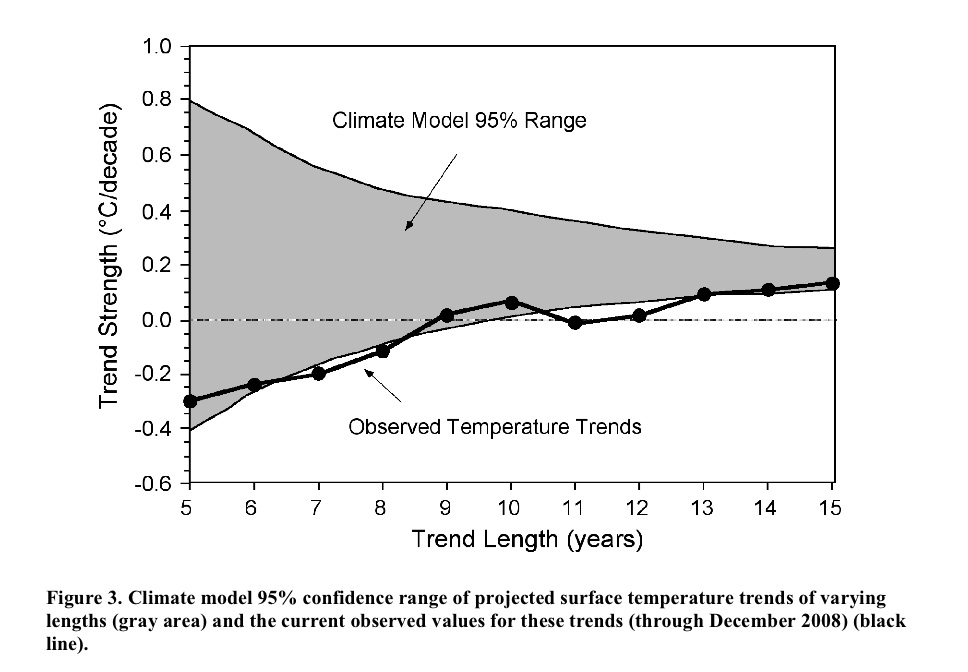
The figure in question was first revealed in Michaels' recent testimony to Congress:

The idea is that you calculate the trends in the observations to 2008 starting in 2003, 2002, 2001…. etc, and compare that to the model projections for the same period. Nothing wrong with this in principle. However, while it initially looks like each of the points is bolstering the case that the real world seems to be tracking the lower edge of the model curve, these points are not all independent. For short trends, there is significant impact from the end points, and since each trend ends on the same point (2008), an outlier there can skew all the points significantly. An obvious question then is how does this picture change year by year? or if you use a different data set for the temperatures? or what might it look like in a year's time? Fortunately, this is not rocket science, and so the answers can be swiftly revealed.

First off, this is what you would have got if you'd done this last year:

which might explain why it never came up before. I've plotted both the envelope of all the model runs I'm using and 2 standard deviations from the mean. Michaels appears to be using a slightly different methodology that involves grouping the runs from a single model together before calculating the 95% bounds. Depending on the details that might or might not be appropriate - for instance, averaging the runs and calculating the trends from the ensemble means would incorrectly reduce the size of the envelope, but weighting the contribution of each run to the mean and variance by the number of model runs might be ok.

Of course, even using the latest data (up to the end of 2008), the impression one gets depends very much on the dataset you are using:

More interesting perhaps is what it will likely look like next year once 2009 has run its course. I made two different assumptions -- that this year will be the same as last year (2008), or that it will be the same as 2007. These two assumptions bracket the result you get if you simply assume that 2009 will equal the mean of the previous 10 years. Which of these assumptions is most reasonable remains to be seen, but the first few months of 2009 are running significantly warmer than 2008. Nonetheless, it's easy to see how sensitive the impression being given is to the last point and the dataset used.

It is thus unlikely this new graph would have seen the light of day had it come up in 2007; and given that next year will likely be warmer than last year, it is not likely to come up again; and since the impression of 'failure' relies on you using the HadCRUT3v data, we probably won't be seeing too many sensitivity studies either.

To summarise, initially compelling pictures whose character depends on a single year's worth of data and only if you use a very specific dataset are unlikely to be robust or provide much guidance for future projections. Instead, this methodology tells us a) that 2008 was relatively cool compared to recent years and b) short term trends don't tell you very much about longer term ones. Both things we knew already.

Next.

Link to Real Climate: http://www.realclimate.org/index.php/archives/2009/03/michaels-new-graph/

George Monbiot: Climate change – The semantics of denial

Climate change: The semantics of denial

They claim they're sceptics – but when any explanation will do as long as it backs their theories, 'climate change deniers' is the only term good enough

David Bellamy

What's in a word? ... David Bellamy. Photograph: David Cheskin/PA

I was hoping to stage round four of the fight for the prestigious Christopher Booker prize for climate change bullshit this week, after the reigning world champion promised to come out of retirement to defend his title. But sadly David Bellamy, despite his extravagant promises to destroy the competition, hasn't yet weighed in, so we'll have to hold on for another tantalising week.

I hope he doesn't chicken out. He could be the only person who can now secure this beautiful trophy for the United Kingdom against the Michigan Mauler, John Tomlinson.

In the meantime, I want to take issue with a comment by my colleague James Randerson. In his excellent blog this week about our dear friend from the Sunday Telegraph James said the following:

I have always disliked the phrase "climate change denier." Global warming will have extremely serious consequences for people around the world, but making the link with the 20th century's most colossal work of industrial-scale evil – the Holocaust – plays into the hands of those who want to convince the waverers that this is purely a political argument.

James's comment is already causing a measure of delight among – ahem – the climate change deniers. That's hardly surprising: they have spent the past few years furiously denying that they are deniers, using the argument that James has adopted.

I use the term deniers not because I am seeking to make a link with the Holocaust, but because I can't think what else to call them. They describe themselves as sceptics, but this is plainly wrong, as they will believe any old rubbish that suits their cause. They will argue, for example, that a single weather event in one part of the world is evidence of global cooling; that the earth is warming up because of cosmic rays and that the Antarctic is melting as a result of volcanoes under the ice. No explanation is too bonkers for them, as long as it delivers the goods.

The OED defines a sceptic as, "A seeker after truth; an inquirer who has not yet arrived at definite conclusions." This is the opposite of what people like Booker, Bellamy and Tomlinson are. They have their definite conclusion and will defend it against all comers, however many inconvenient truths might stand in the way.

There is another class of people, whose materials these independent deniers often use: those who are paid by corporations to defend definite conclusions. I have documented this trade extensively (see also my book Heat). But many of these people still masquerade as free thinkers. Earlier this month, for example, The Guardian's "Comment is Free" site published an article by Patrick Michaels. The Guardian described him as "a senior fellow at the Cato Institute and author of Climate of Extremes." What it didn't say is that he has been paid extremely well in the recent past to promote the views he expressed here by interests which, as far as I can discover, he has never voluntarily disclosed.

Take a look at this leaked memo circulated by the Intermountain Rural Electric Association (IREA) in 2006. IREA transmits electricity – most of which is produced by coal-burning power stations – across the U.S. Midwest.

The memo reveals that IREA was about to start buying electricity from a new coal-fired plant, replacing some of the gas production it was using before. But the cost advantages would be wiped out if a carbon tax were imposed. In the hope of averting this prospect, IREA had:

decided to support Dr Patrick Michaels and his group (New Hope Environmental Services, Inc). Dr Michaels has been supported by electric cooperatives in the past and also receives financial support from other sources ... In February of this year IREA alone contributed $100,000 to Dr Michaels. In addition we have contacted all the G&T's [generators and transmitters of electricity] in the United States and as of the writing of this letter, we have obtained additional contributions and pledges for Dr Michaels group.

I posted this information up in the comment thread following Dr Michaels's article, but it was deleted by the moderator. I'm not sure why.

Whether we're talking about people who are paid to deny that climate change is happening, or those who use the materials these flacks produce, denial is a precise and concise description of what they do. Their attempt to wriggle out of it by insisting that – by calling them what they are – we are somehow debasing the Holocaust is as contrived as all the other positions they take. We shouldn't fall for it.

Link to this article: http://www.guardian.co.uk/environment/georgemonbiot/2009/feb/27/climate-change-deniers-sceptics