Showing posts with label North Atlantic Oscillation. Show all posts

Joseph Romm: Global warming is driving increased frequency of extreme wet or dry summer weather in southeast, so droughts and deluges are likely to get worse


by Joseph Romm, Climate Progress, October 28, 2010
A new study by a Duke University-led team of climate scientists suggests thatglobal warming is the main cause of a significant intensification in the North Atlantic Subtropical High (NASH) that in recent decades has more than doubled the frequency of abnormally wet or dry summer weather in the southeastern United States.
Increasingly Variable Summer Rainfall in Southeast Linked to Climate ChangeThe NASH, commonly referred to as the Bermuda High, is an area of high pressure that forms each summer near Bermuda, where its powerful surface center helps steer Atlantic hurricanes and plays a major role in shaping weather in the eastern United States, Western Europe and northwestern Africa.
That’s from the Duke University news release for a new study in the Journal of Climate.
In a September 2009 post, “Hell and High Water hits Georgia,” I noted that, “as climate scientists have predicted for a long time, wild climate swings are becoming the norm, in this case with once-in-a-century drought followed by once-in-a-century flooding.”  And in fact, the flooding was more like a once in 500 year event.
Now a team of scientists has quantified the rise in extreme wet and dry summer weather — and finds global warming is likely the main cause.  The release continues:

By analyzing six decades of U.S. and European weather and climate data, the Duke-led team found that the center of the NASH intensified by 0.9 geopotential meters a decade on average from 1948 to 2007.  (Geopotential meters are used to measure how high above sea level a pressure system extends; the greater the height, the greater the intensity. 
The team’s analysis found that as the NASH intensified, its area enlarged, bringing the high’s weather-making western ridge closer to the continental United States by 1.22 longitudinal degrees a decade. 
“This is not a natural variation like El Nino,” says lead author Wenhong Li, assistant professor of earth and ocean sciences at Duke University’s Nicholas School of the Environment.   “We thoroughly investigated possible natural causes, including the Atlantic Multivariate Oscillation (AMO) and Pacific Decadal Oscillation (PDO), which may affect highs, but found no links. 
“Our analysis strongly suggests that the changes in the NASH are mainly due to anthropogenic warming,” she says. 
An early online edition of the study, published in the Journal of Climate, is available at the American Meteorological Society’s website at http://journals.ametsoc.org/ doi/ pdf/ 10.1175/ 2010JCLI3829.1.
The study has a firewall.  For the text alone, you can get around it here.
As the NASH intensified and migrated westward, Li’s team’s analysis found that its meridional variation, or north-south movement, also was enhanced from 1978 to 2007, a period when the frequency of extreme summer rainfall variability in the Southeast more than doubled over the previous 30 years.  
From 1978 to 2007, 11 summers – defined in this study as the months of June, July and August – had total seasonal precipitation anomalies greater than one standard deviation from the mean.  Six of the summers were abnormally wet, while five were abnormally dry. 
To forecast future trends in the NASH’s intensity, the team used climate models developed for use by the Intergovernmental Panel on Climate Change’s Fourth Assessment Report in 2007. The models – known as  Coupled Model Intercomparison Project Phase 3 (CMIP3) models – predict the NASH will continue to intensify and expand as concentrations of carbon dioxide and other greenhouse gases increase in Earth’s atmosphere in coming decades
This intensification will further increase the likelihood of extreme summer precipitation variability – periods of drought or deluge – in southeastern states in coming decades,” Li says. 
If the NASH ‘s western ridge’s meridional movement jogs a little to the north as it expands, the likelihood increases for more extreme dry weather in the Southeast that summer, she explains. If the NASH wobbles a little to the south, extreme wet weather becomes more likely… 
In addition to long-term rainfall data and the CMIP3 models, the team used atmospheric reanalysis data from the U.S. National Center for Environmental Prediction/National Center for Atmospheric Research and the European Centre for Medium-Range Weather Forecasts to conduct the study.
For a meteorologist’s take on the amazing 2009 Georgia flooding, also using the NCEP reanalysis data, see “Weather Channel expert on Georgia’s record-smashing global-warming-type deluge.”

The peer-reviewed analysis concludes that “the NASH system will likely intensify, expand and move further westward in the 21st century with the increase of CO2, indicating increased likelihoods of both extreme rainfall events and droughts over the SE US in the future.”

The scary part, as I’ve said many times, is that we’ve only warmed about a degree Fahrenheit in the past half-century.  We are on track to warm nearly 10 times that this century (see M.I.T. doubles its 2095 warming projection to 10 °F — with 866 ppm and Arctic warming of 20 °F ). 

And that’s just business as usual. 

The plausible worst-case scenario is beyond comprehension:
Drought and deluge — Hell and High Water — we ain’t seen nothing yet!

Link:  http://climateprogress.org/2010/10/28/global-warming-extreme-wet-dry-summer-weather-in-southeast-droughts-and-deluges/

Ocean Conveyor's 'Pump' Switches Back On

Ocean Conveyor's 'Pump' Switches Back On

How will climate warming affect ocean circulation? The answer isn't so simple.


by Lonny Lippsett, Woods Hole Oceanographic Institution, January 9, 2009


The Greenland tip jet is a sporadic, low-level atmospheric jet stream characterized by fierce winds on the lee side of Cape Farewell on the southern tip of Greenland. As storms pass through from the southwest, high-level winds descend the glacial slopes on the eastern side of Greenland, accelerating as they drop down over the ocean. In the process, they draw cold air into a relatively small area over the southern Irminger Sea. This phenomenon appears to play a critical role in chilling North Atlantic waters so that they sink to great depths and drive part of the global ocean circulation and climate system. Using NOAA's QuikSCAT satellite, MIT/WHOI Joint Program graduate student Kjetil Våge compiled this image of a tip jet on Dec. 5, 2002. Color indicates wind speeds in meters per second; arrows indicate wind direction. (Courtesy of Kjetil Våge, Woods Hole Oceanographic Institution.)


Enlarge Image In the North Atlantic Ocean, the contrast between frigid, dry winter air and warm water draws heat from the ocean into the atmosphere and leaves ocean water colder and denser. The denser waters sink and feed into the lower limb of a global system of currents often described as the Ocean Conveyor. The process, called deep convection, has far-reaching affects on climate. (Illustration by Jack Cook, Woods Hole Oceanographic Institution)


One of the  “pumps” that helps drive the ocean’s global circulation suddenly switched on again last winter for the first time this decade. The finding surprised scientists who had been wondering if global warming was inhibiting the pump and did not foresee any indications that it would turn back on.

The “pump” in question is in the western North Atlantic Ocean, where pools of cold, dense water form in winter and sink beneath less-dense warmer waters. The sinking water feeds into the lower limb of a global system of currents often described as the Great Ocean Conveyor (View animation (Quicktime)). To replace the down-flowing water, warm surface waters from the tropics are pulled northward along the Conveyor’s upper limb.

The phenomenon has far-reaching impacts on climate. It transports tropical heat to the North Atlantic region, keeping winters there much warmer than they would be otherwise. And it draws down the man-made buildup of carbon dioxide from air to surface waters and eventually into the depths, where the greenhouse gas is stored for centuries and offset global warming.

The pump is driven by the contrast between warm water and frigid, dry winter air, which draws heat from the ocean into the atmosphere and leaves ocean water colder and denser. Over the last 15 years, the sinking of cold water in the North Atlantic has been either absent or too shallow to feed into the deep Conveyor. Scientists have speculated that a cause could be generally warming air temperatures, which also melts polar ice and adds less-dense fresh water to the ocean. That overall trend didn’t change in 2007, and in fact, Arctic Ocean sea ice disappeared to a record minimum in the summer of 2007.

Yet the sinking of cold water in the North Atlantic resumed vigorously, a research team led by Kjetil Våge and Robert Pickart of Woods Hole Oceanographic Institution reported in the December 23, 2008, issue of Nature Geoscience. “The obvious question is, why?” wrote Våge, Pickart, and colleagues.

A fleet of floats
Their investigations turned up a myriad of interrelated, nuanced factors that make it difficult to predict future changes in ocean circulation and climate, concluded the research team, which also included Virginie Thierry (Laboratoire de Physique des Océans), Gilles Reverdin (Laboratoire d'Océanographie Dynamique et de Climatologie), Craig M. Lee (University of Washington), Brian Petrie (Bedford Institute of Oceanography), Tom A. Agnew and Amy Wong (Meteorological Service of Canada), and Mads H. Ribergaard (Danish Meteorological Institute).

The researchers examined new data collected by robotic floats that have been drifting for several years in the Labrador and Irminger Seas around southern Greenland. These Argo floats—part of a fleet of 3,000 dispatched since 2000 through the world’s oceans—descend to depths of 1.25 miles (2,000 meters), collect temperature and salinity data as they periodically rise toward the surface, and then transmit the data via satellite before descending again (View animation (Quicktime)). Unlike ships that usually (and wisely) avoid rough North Atlantic seas in winter, the Argo floats provide a way to detect the sinking of cold waters in the season that it occurs.

The Argo float data showed that in the winter of 2007-2008, cold water sank significantly beyond 0.62 miles (1,000 meters) deep in northern seas for the first time in eight years and for only the second time since the mid-1990s. Beyond that depth, waters can be swept into lower limb of the Conveyor and carried around the world.

Sinking was undoubtedly enhanced last winter by air temperatures over the North Atlantic that were 9-11 °F (5-6 °C) colder than in the previous seven years. That often occurs when a seesawing pattern of high- and low-pressure air masses, called the North Atlantic Oscillation, is in its “positive” position, bringing frigid westerly winds from Canada streaking across the North Atlantic. But, curiously, that was also the case in 2006-2007, in which sinking did not occur.
 
The lack of substantial sinking throughout the decade meant that there was no “preconditioning”—that is, colder waters could not build up from previous winters to a point where they are easily pushed over a density threshold and sink the following year, the research team said. That made the sudden reappearance of sinking in 2007-2008 all the more surprising.

Tip jets and exported ice
Digging deeper, the researchers found that local wind patterns, which occurred in 2007-2008 (but not the preceding winter), may have played a role. In particular, storms tended to track farther to the south, pulling cold air off the ice edge of eastern Canada into the Labrador Sea. The same storms also continued past Cape Farewell at the southern tip of Greenland, creating a phenomenon known as Greenland tip jets: High winds from the west deflect around the glacial slopes of Greenland, accelerating as they draw cold, ocean-chilling air into a relatively small area over the southern Irminger Sea.

A final clue emerged. Analyzing satellite and in-situ ocean data, the researchers said a large amount of pack ice and fresh water was exported into the northwest Labrador Sea in the summer of 2007. This froze the following winter, significantly extending the ice edge farther offshore. As a consequence, cold air from the North American continent traveled farther over ice, instead of warmer ocean waters, remaining cold until it hit warmer open water in the middle of Labrador Sea. The resulting temperature contrast helped trigger the sinking process.

The scientists noted “that the increased liquid and frozen freshwater flux into the Labrador Sea was probably tied to the large export of sea ice from the Arctic Ocean that contributed to the record minimum in sea-ice extent observed in the summer of 2007. Ironically, this disappearance of Arctic sea ice, which has been linked to global warming, may have helped trigger the return of deep wintertime [water sinking] to the North Atlantic.”

A National Science Foundation grant supported this research
. Originally published January 9, 2009; last updated September 3, 2009

Link:  http://www.whoi.edu/page.do?pid=12455&tid=282&cid=54347

B. J. Peterson et al., Science, 313(5790), Trajectory shifts in the Arctic and subarctic freshwater cycle

See also:  http://climatechangepsychology.blogspot.com/search?q=Sarafanov


Science (25 August 2006), Vol. 313, No. 5790, pp. 1061-1066; DOI: 10.1126/science.1122593

Review

Trajectory shifts in the Arctic and subarctic freshwater cycle

Bruce J. Peterson1,*, James McClelland2, Ruth Curry3, Robert M. Holmes4, John E. Walsh5 and Knut Aagaard6

Abstract

Manifold changes in the freshwater cycle of high-latitude lands and oceans have been reported in the past few years. A synthesis of these changes in freshwater sources and in ocean freshwater storage illustrates the complementary and synoptic temporal pattern and magnitude of these changes over the past 50 years. Increasing river discharge anomalies and excess net precipitation on the ocean contributed ~20,000 cubic kilometers of fresh water to the Arctic and high-latitude North Atlantic oceans from lows in the 1960s to highs in the 1990s. Sea ice attrition provided another ~15,000 cubic kilometers, and glacial melt added ~2000 cubic kilometers. The sum of anomalous inputs from these freshwater sources matched the amount and rate at which fresh water accumulated in the North Atlantic during much of the period from 1965 through 1995. The changes in freshwater inputs and ocean storage occurred in conjunction with the amplifying North Atlantic Oscillation and rising air temperatures. Fresh water may now be accumulating in the Arctic Ocean and will likely be exported southward if and when the North Atlantic Oscillation enters into a new high phase.


1 Ecosystems Center, Marine Biological Laboratory, Woods Hole, MA 02543, USA.
2 Marine Science Institute, University of Texas at Austin, Port Aransas, TX 78373, USA.
3 Woods Hole Oceanographic Institution, MS 21, Woods Hole, MA 02543, USA.
4 Woods Hole Research Center, 149 Woods Hole Road, Falmouth, MA 02540, USA.
5 International Arctic Research Center, 930 Koyukuk Drive, Post Office Box 75340, Fairbanks, AK 99775, USA.
6 Applied Physics Laboratory, University of Washington, 1013 NE 40th Street, Seattle, WA 98105, USA. 

 
*Correspondence e-mail: peterson@mbl.edu


Link to abstract:  https://www.sciencemag.org/cgi/content/abstract/313/5790/1061

Michael E. Mann et al., Science 326 (2009), Global signatures and dynamical origins of the Little Ice Age and Medieval Climate Anomaly

Science (27 November 2009), Vol. 326, No. 5957, pp. 1256-1260; DOI: 10.1126/science.1177303

Global Signatures and Dynamical Origins of the Little Ice Age and Medieval Climate Anomaly

Michael E. Mann,1,* Zhihua Zhang,1 Scott Rutherford,2 Raymond S. Bradley,3 Malcolm K. Hughes,4 Drew Shindell,5 Caspar Ammann,6 Greg Faluvegi,5 and Fenbiao Ni4 

Abstract

Global temperatures are known to have varied over the past 1500 years, but the spatial patterns have remained poorly defined. We used a global climate proxy network to reconstruct surface temperature patterns over this interval. The Medieval period is found to display warmth that matches or exceeds that of the past decade in some regions, but which falls well below recent levels globally. This period is marked by a tendency for La Niña–like conditions in the tropical Pacific. The coldest temperatures of the Little Ice Age are observed over the interval 1400 to 1700 C.E., with greatest cooling over the extratropical Northern Hemisphere continents. The patterns of temperature change imply dynamical responses of climate to natural radiative forcing changes involving El Niño and the North Atlantic Oscillation–Arctic Oscillation.

*Correspondence e-mail: mann@meteo.psu.edu

Link to abstract:  http://www.sciencemag.org/cgi/content/short/326/5957/1256

Of moles and whacking: “Mojib Latif predicted two decades of cooling” [Tenney here: NOT!]

Of moles and whacking: “Mojib Latif predicted two decades of cooling” [Tenney here:  NOT!]

The Way Things Break blog, September 11, 2009 · 59 Comments

Or: Journalists should report what climate science actually “says”, rather than what they mistakenly “believe” it to say – Part II

In Part I we looked at some issues relating to climate science that the Houston Chronicle’s “SciGuy” Eric Berger was mistaken about and had blamed “climate scientists” for. And while pointing out that it isn’t particularly fair for Mr. Berger to blame climate scientists for his misunderstandings, it would also be unfair to say that his confusion was his fault alone.

Fred Pearce wrote a recent column for New Scientist claiming climate modeler Mojib Latif predicted that up to two decades of cooling were coming: “We could be about to enter one or even two decades of cooler temperatures, according to one of the world’s top climate modellers.” Pearce’s claim was promptly picked up by the denialosphere and has been cited by “skeptics” as well as those who believe climate science is undergoing some sort of shake up, like Mr. Berger. Pearce’s story is greatly misleading both in terms of what Latif actually said and the role climate scientists believe natural variability plays in the climate system.

First a bit of background: Pearce’s story was written about a recent climate summit: the World Climate Conference-3. Part of the summit was dedicated to Advancing Climate Prediction Science; Latif’s presentation was concerned with decadal-scale climate predictions -- concerning not only their potential value and viability but also the significant challenges that remain before we can make useful ones.

On interannual (more than a single year) and decadal (tens of years) scales, natural variability swamps the long term anthropogenic warming trend. That is to say that variations in naturally occurring aspects of the climate system have more of an impact on the ultimate value of, say, global average temperature over a span of 10 or so years than man-made global warming does. For example, changes in ENSO are one of the largest sources of natural variability and thus influence on global average temperatures in the climate system on interannual scales. In 1998, a very strong El Niño boosted the global average temperature much higher than the overall trend, while in 2008, a persistent La Niña in cahoots with a solar minimum ensured that temperature was in the top 10 (#9 for NASA, #10 for Met Hadley) hottest years on record, but not a record breaker.
While this might be surprising for some readers, let’s be clear: This is not “new” information. This does not represent a “shake up” of the climate science community’s understanding of the system, or a blow to “settled science.” This is acknowledged in the IPCC’s most recent Assessment Report (AR4 WG1 8.3 and 9.4) as well as in the relevant primary literature. For example, the AR4 Synthesis Report states:
On scales [smaller than 50 years], natural climate variability is relatively larger [than human influences], making it harder to distinguish changes expected due to external [e.g., man-made] forcings.
Latif begins the section of his presentation misrepresented by Pearce by confirming that the media incorrectly believes that global warming is monotonic- something that we know the warming is decidedly not; something not claimed by “climate science” or “climate scientists.” Significant natural variability is superimposed on the long term man-made warming trend. Although the press might expect for us to set a new temperature record every year, the existence of natural variability means that we could in theory wait a long time (~17 years) before setting a new temperature record. Latif imagines ‘what if’:
It may well happen that you enter a decade, or maybe even two -- you know -- when the temperature cools -- all right -- relative to the present level -- all right?

And then -- you know -- I know what’s going to happen -- you know? I will get -- you know -- millions of phone calls -- you know:
“Eh, what’s going on? So, is global warming disappearing?” You know? “Have you lied on [sic] us?”
So -- you know -- and therefore this is the reason why we need to address this decadal prediction issue.
[ed. note: "entering... two [decades]” depending on the usage can take as little as 11 years, “enter[ing]” a decade” as little as one]

This was not an explicit prediction by Latif -- it was a hypothetical scenario that is a real, if  not necessarily likely, possibility. Latif is saying that because people don’t understand that global warming isn’t supposed to be monotonic, and that there could be periods where temperatures pause or even dip below the present, the media and/or public will incorrectly believe that global warming has stopped/was wrong, etc., even though such “pauses” in warming are decidedly not contrary to our understanding of the climate system and how we anticipate it will respond to emissions driven warming.

Of course this is like cat nip to the denialists and their fellow travelers like Roger Pielke Jr. It feeds into the caricature, enabled by sloppy journalism, that nearly everything can happen because of global warming [often phrased, "Global warming, is there anything it can't do?" Sometimes with 'global warming' stricken out and replaced with 'climate change'].

Latif goes on to describe a number of phenomena that have an overall trend but are dominated on the interannual and even decadal scales by natural variability: Sahel rainfall, Atlantic tropical cyclones, regional sea levels. Again, none of this is new, none of it was presented as new. This represents no paradigm shift within climate science.

Latif then switches gears to model initialization. When the IPCC offers projections of global temperature change into the next 100 years, these are not predictions- as previously discussed. And dealing with interannual or decadal predictions instead of looking at the changes to temperature trends 100 years out is a difference between an initial value problem and a boundary value (or in Latif’s words, a “boundary force”) problem. Uncertainties about emissions scenarios (how much carbon we decide to burn) and model biases are the dominant areas of uncertainty for end-of-century projections of changes of how temperature will trend.

However, on much shorter scales, such as interannual or decadal scales, can you guess what the largest source of uncertainty becomes? Yep, that’s right, natural variability. Prediction on such short timescales then becomes at least partially an initial value problem. Latif rightly understands that such short term predictions depend on accurate understanding and modeling of initialization factors like variance in the North Atlantic Oscillation. You might remember when a team he was part of made some waves in predicting a temporary pause in warming/global cooling in their attempt to initialize a climate model to make a deliberate prediction (rather than say an end-of-century projection) of temperature for the next few decades. Suffice it to say that not everyone has found the basis of their prediction (of no immediate warming) particularly compelling.
Latif’s warning, garbled though it became regarding the reality and difficulty in predicting natural variability, deserves to be acknowledged. It’s exceedingly difficult for me to see, however, how or why the presentation was subsequently spun in the manner that it was, or why science journalists like Mr. Berger would accept said spin so uncritically.

Pearce’s article gives the false impression that there is a “new” or “growing” dissent from the broad strokes consensus on climate change. This couldn’t be further from the truth. I appreciate Pearce’s concern (that the existence of natural variability can embolden denialists), but it sounds like this concern has caused him to unnecessarily and inaccurately frame Latif’s presentation as a challenge to the scientific consensus on climate change. Natural variability is of course real. It can and will overwhelm man-made warming on shorter timescales. That journalists are beginning to pay attention to this simple fact is not a reflection of a sea change in our understanding of climate science.

Latif’s presentation and audio [LATE UPDATE: The audio has moved, it's now here under "Advancing Climate Prediction Science"; the presentation is available here] are available for anyone to examine. We can look at Mr. Berger and others’ claims about hurricanes/tropical cyclones and anthropogenic warming in a Part III, if there is interest.

[Fixed some spelling errors and reworded the penultimate paragraph for clarity]
Link to The Way Things Break blog post:  http://thingsbreak.wordpress.com/2009/09/11/of-moles-and-whacking-mojib-latif-predicted-two-decades-of-cooling/

Greenland Ice Sheet’s elevation change in winter and atmospheric circulation

Nuuk Climate Days 2009 -- Changes of the Greenland Cryosphere Workshop & The Arctic Freshwater Budget International Symposium, Nuuk, Greenland, 25-27 August 2009

Primary author: CHEN, Linling (Nansen-Zhu International research center/Institute of Atmospheric Physics,
Chinese Academy of Sciences), lin-ling.chen@nersc.no ; Co-authors: JOHANNESSEN, Ola M. (Nansen Environmental and Remote Sensing Center); WANG, Huijun (Nansen-Zhu International research center/Institute of Atmospheric Physics, Chinese Academy of Sciences);  KHVOROSTOVSKY, Kirill (Nansen Environmental and Remote Sensing Center)

Abstract ID: F4
 

Greenland Ice Sheet’s elevation change in winter and atmospheric circulation

Data from ERS-1, ERS-2 and Envisat Satellites are analyzed to identify the relationship between winter elevation variations of Greenland ice sheet and sea level pressure during 1993-2007. It is found that the North Pacific oscillation and the North Atlantic oscillation, the two major teleconnection patterns of surface pressure fields in North Hemisphere, both have significant impacts on the Greenland ice sheet winter elevation change by influencing accumulation. In addition, we are evaluating modeled precipitation data over Greenland based on comparison with accumulation data from all available ice core records and meteorological station, in order to better understand how the atmospheric circulation impact the Greenland Ice Sheet’s Elevation.

Kjetil Våge et al., Nature Geosci., Surprising return of deep convection to the subpolar North Atlantic Ocean in winter 2007–2008

Nature Geoscience, 2 (2008) 67-72, published online 30 November 2008; doi: 10.1038/ngeo382

Surprising return of deep convection to the subpolar North Atlantic Ocean in winter 2007–2008

Kjetil Våge1, Robert S. Pickart1, Virginie Thierry2, Gilles Reverdin3, Craig M. Lee4, Brian Petrie5, Tom A. Agnew6, Amy Wong6 and Mads H. Ribergaard7

Abstract

In the process of open-ocean convection in the subpolar North Atlantic Ocean, surface water sinks to depth as a distinct water mass, the characteristics of which affect the meridional overturning circulation and oceanic heat flux. In addition, carbon is sequestered from the atmosphere in the process. In recent years, this convection has been shallow or non-existent, which could be construed as a consequence of a warmer climate. Here we document the return of deep convection to the subpolar gyre in both the Labrador and Irminger seas in the winter of 2007–2008. We use profiling float data from the Argo programme to document deep mixing. Analysis of a variety of in situ, satellite and reanalysis data shows that contrary to expectations the transition to a convective state took place abruptly, without going through a phase of preconditioning. Changes in hemispheric air temperature, storm tracks, the flux of fresh water to the Labrador Sea and the distribution of pack ice all contributed to an enhanced flux of heat from the sea to the air, making the surface water sufficiently cold and dense to initiate deep convection. Given this complexity, we conclude that it will be difficult to predict when deep mixing may occur again.

  1. Woods Hole Oceanographic Institution, Woods Hole, MA 02543, USA
  2. IFREMER, Laboratoire de Physique des Océans, UMR 6523 CNRS/IFREMER/IRD/UBO, 29280 Plouzané, France
  3. Laboratoire d'Océanographie Dynamique et de Climatologie, FR-75252 Paris, France
  4. Applied Physics Laboratory, University of Washington, Seattle, WA 98105, USA
  5. Bedford Institute of Oceanography, Dartmouth, Nova Scotia B2Y 4A2, Canada
  6. Meteorological Service of Canada, Downsview, Ontario M3H 5T4, Canada
  7. Danish Meteorological Institute, DK-2100 Copenhagen, Denmark

Correspondence to: Kjetil Våge1 e-mail: kjetil@whoi.edu

Link to abstract: http://www.nature.com/ngeo/journal/v2/n1/abs/ngeo382.html

A. Sarafanov: On the effect of the North Atlantic Oscillation on temperature and salinity of the subpolar North Atlantic intermediate and deep waters

ICES Journal of Marine Science, 66(7) (2009) 1448-1454; doi:10.1093/icesjms/fsp094

On the effect of the North Atlantic Oscillation on temperature and salinity of the subpolar North Atlantic intermediate and deep waters

Artem Sarafanov

Shirshov Institute of Oceanology, 36 Nakhimovskiy Prospect, 117997 Moscow, Russia

Received 15 August 2008; accepted 18 February 2009; advance access publication 17 April 2009.

Abstract

The close relationship between the observed water mass properties and the winter North Atlantic Oscillation (NAO) index (1950–2000s; r2 {approx} 0.65) implies that changes in the NAO-related atmospheric forcing may account for up to two-thirds of thermohaline changes at the intermediate and deep levels in the subpolar North Atlantic on a decadal time-scale. Persistent NAO decline (amplification) results in increase (decrease) in temperature and salinity in the intermediate–deep water column. A general mechanism explaining the close link between the NAO and coherent decadal changes in the intermediate and deep-water temperature and salinity in the region is inferred from the observed changes in the regional circulation and water mass properties. Two factors dominate this link: (i) intensity of convection in the Labrador Sea controlling injection of relatively cold freshwater into the intermediate layer, and (ii) zonal extension of the Subpolar Gyre that regulates the relative contribution of cold fresh subpolar water and warm saline subtropical water to the deep-water formation.

Key words: Labrador Sea Water, long-term changes, North Atlantic Oscillation, overflow, Subpolar Gyre, Subtropical Gyre

tel: +7 916 279 7324; fax: +7 499 124 6142; e-mail: sarafanov@mail.ru

Sarafanov, A. 2009. On the effect of the North Atlantic Oscillation on temperature and salinity of the subpolar North Atlantic intermediate and deep waters. ICES Journal of Marine Science, 66: 1448–1454.

Link to abstract: http://icesjms.oxfordjournals.org/cgi/content/abstract/66/7/1448

M.M. Fauria et al., Climate Dynamics, Unprecedented low twentieth century winter sea ice extent in the Western Nordic Seas since A.D. 1200

Climate Dynamics (June 23, 2009); DOI: 10.1007/s00382-009-0610-z

M. Macias Fauria1, 2, 5, 10 Contact Information, A. Grinsted4, 3, S. Helama2, J. Moore3, 6, 7, M. Timonen5, T. Martma9, E. Isaksson8 and M. Eronen2

(1) Biogeoscience Institute, University of Calgary, Calgary, AB, Canada
(2) Department of Geology, University of Helsinki, Helsinki, Finland
(3) Arctic Centre, University of Lapland, Rovaniemi, Finland
(4) Centre for Ice and Climate, Niels Bohr Institute, University of Copenhagen, Copenhagen, Denmark
(5) Rovaniemi Research Station, Finnish Forest Institute, Rovaniemi, Finland
(6) Thule Institute, University of Oulu, Oulu, Finland
(7) College of Global Change and Earth System Science, Beijing Normal University, Beijing, China
(8) Polar Environmental Centre, Norwegian Polar Institute, Tromsø, Norway
(9) Institute of Geology, Tallinn University of Technology, Tallinn, Estonia
(10) Department of Ecology, Faculty of Biology, University of Barcelona, Av. Diagonal 645, 08028 Barcelona, Spain

(Received 1 October 2008, accepted 9 June 2009, published online 23 June 2009.)

Abstract

We reconstructed decadal to centennial variability of maximum sea ice extent in the Western Nordic Seas for A.D. 1200–1997 using a combination of a regional tree-ring chronology from the timberline area in Fennoscandia and δ18O from the Lomonosovfonna ice core in Svalbard. The reconstruction successfully explained 59% of the variance in sea ice extent based on the calibration period 1864–1997. The significance of the reconstruction statistics (reduction of error, coefficient of efficiency) is computed for the first time against a realistic noise background. The twentieth century sustained the lowest sea ice extent values since A.D. 1200: low sea ice extent also occurred before (mid-seventeenth and mid-eighteenth centuries, early fifteenth and late thirteenth centuries), but these periods were in no case as persistent as in the twentieth century. Largest sea ice extent values occurred from the seventeenth to the nineteenth centuries, during the Little Ice Age (LIA), with relatively smaller sea ice-covered area during the sixteenth century. Moderate sea ice extent occurred during thirteenth–fifteenth centuries. Reconstructed sea ice extent variability is dominated by decadal oscillations, frequently associated with decadal components of the North Atlantic Oscillation/Arctic Oscillation (NAO/AO), and multi-decadal lower frequency oscillations operating at ~50–120 year. Sea ice extent and NAO showed a non-stationary relationship during the observational period. The present low sea ice extent is unique over the last 800 years, and results from a decline started in late-nineteenth century after the LIA.

M. Macias Fauria, e-mail: mmaciasf@ucalgary.ca

Link to abstract: http://www.springerlink.com/content/922v30um17650817/

Casey Saenger et al., Nature Geosci., 2009, Surface-temperature trends and variability in the low-latitude North Atlantic since 1552

Nature Geoscience, published online 21 June 2009; doi:10.1038/ngeo552

Surface-temperature trends and variability in the low-latitude North Atlantic since 1552

Casey Saenger1, Anne L. Cohen2, Delia W. Oppo2, Robert B. Halley3 and Jessica E. Carilli4

Abstract

Sea surface temperature variability in the North Atlantic Ocean recorded since about 1850 has been ascribed to a natural multidecadal oscillation superimposed on a background warming trend1, 2, 3, 4, 5, 6. It has been suggested that the multidecadal variability may be a persistent feature6, 7, 8, raising the possibility that the associated climate impacts may be predictable9. However, our understanding of the multidecadal ocean variability before the instrumental record is based on interpretations of high-latitude terrestrial proxy records7, 8. Here we present an absolutely dated and annually resolved record of sea-surface temperature from the Bahamas, based on a 440-year time series of coral growth rates. The reconstruction indicates that temperatures were as warm as today from about 1552 to 1570, then cooled by about 1 °C from 1650 to 1730 before warming until the present. Our estimates of background variability suggest that much of the warming since 1900 was driven by anthropogenic forcing. Interdecadal variability with a period of 15–25 years is superimposed on most of the record, but multidecadal variability becomes significant only after 1730. We conclude that the multidecadal variability in sea-surface temperatures in the low-latitude western Atlantic Ocean may not be persistent, potentially making accurate decadal climate forecasts more difficult to achieve.

  1. Massachusetts Institute of Technology and Woods Hole Oceanographic Institution Joint Program in Oceanography, Woods Hole, MA 02543, U.S.A.
  2. Department of Geology and Geophysics, Woods Hole Oceanographic Institution, Woods Hole, MA 02543, U.S.A.
  3. US Geological Survey (retired) 13765 2600 Rd., Cedaredge, CO 81413, U.S.A.
  4. University of California San Diego, Scripps Institution of Oceanography, La Jolla, CA 92093, U.S.A.

Correspondence to: Casey Saenger1 e-mail: csaenger@mit.edu

Link to abstract: http://www.nature.com/ngeo/journal/vaop/ncurrent/abs/ngeo552.html

Ric Williams, North Atlantic Oscillation could be masking the overall effect of global warming in the North Atlantic Ocean

Wind patterns could mask effects of global warming in ocean

NOAA satellite image of a negative phase of the North Atlantic Oscillation. In this phase, the North Atlantic jet stream is shifted south of normal over the eastern U.S., and the upstream polar jet stream coming southward from Canada is stronger than normal. In contrast, the positive phase of the NAO features a northward shift of the North Atlantic jet stream pattern over the eastern U.S., and a reduced flow of cold air from Canada. (Credit: NOAA)

ScienceDaily (Feb. 15, 2008) — Scientists at the University of Liverpool have found that natural variability in the earth's atmosphere could be masking the overall effect of global warming in the North Atlantic Ocean.

Scientists have previously found that surface temperatures around the globe have risen over the last 30 years in accord with global warming. New data, however, shows that heat stored in the North Atlantic Ocean has a more complex pattern than initially expected, suggesting that natural changes in the atmosphere also play a role.

The Liverpool team, in collaboration with the University of Duke in the U.S., analysed 50 years of North Atlantic temperature records and used computer models to assess how the warming and cooling pattern was controlled. They found that the tropics and mid-latitudes have warmed, while the sub-polar regions have cooled.

Professor Ric Williams, from the University's School of Earth and Ocean Sciences, explains: "We found that changes in the heat stored in the North Atlantic corresponded to changes in natural and cyclical winds above the North Atlantic. This pattern of wind movement is called the North Atlantic Oscillation (NAO), which is linked to pressure differences in the atmosphere between Iceland and The Azores.

"The computer model we used to analyse our data helped us to predict how wind and heat exchange with the atmosphere affects the North Atlantic Ocean's heat content over time. We found that the warming over the mid latitudes was due to the wind redistributing heat, while the gain in heat in the tropics and loss in heat at high latitudes was due to an exchange of heat with the atmosphere.

"These local changes in heat storage are typically 10 times larger than any global warming trend. We now need to look at why changes are occurring in wind circulation, as this in itself could be linked to global warming effects."

Although natural variability appears to be masking global warming effects in the ocean, scientists still believe that global warming is occurring, as evident through a wide range of independent signals such as rising surface and atmospheric temperatures, reduced Arctic summer sea ice and the reduced extent of many glaciers showing changes in the environment.

The research is published in Science. This study was jointly supported by the UK Natural Environment Research Council (NERC) and the US National Science Foundation.

Link to article: http://www.sciencedaily.com/releases/2008/02/080207101333.htm

T. Mochizuki, T. Awaji, N. Sugiura, GRL, 36, Possible oceanic feedback in the extratropics in relation to the North Atlantic SST tripole

Geophysical Research Letters, 36, L05710; doi:10.1029/2008GL036781

Possible oceanic feedback in the extratropics in relation to the North Atlantic SST tripole

Takashi Mochizuki (Frontier Research Center for Global Change, JAMSTEC, Yokohama, Japan), Toshiyuki Awaji (Frontier Research Center for Global Change, JAMSTEC, Yokohama, and Department of Geophysics, Kyoto University, Kyoto, Japan), and Nozomi Sugiura (Frontier Research Center for Global Change, JAMSTEC, Yokohama, Japan)

Abstract

We analyze the results of 4-dimensional variational data assimilation experiments using a coupled general circulation model and identify signals from a possible extratropical oceanic feedback relating to the North Atlantic Sea Surface Temperature (SST) tripole. Examination of the optimized control variables (coupling parameters) and the resultant climate fields reveals that the model errors in the North Atlantic climate variations are very sensitive to the intensity of the extratropical air-sea thermal coupling. This results in the enhancement of the atmospheric responses to SST changes particularly around 40°N, 50°W, when the model errors are most effectively corrected. Since an adjoint approach enables us to detect the sensitivity to fluctuations in the model variables, our results suggest that this oceanic thermal feedback in the extratropics is a key physical process influencing the North Atlantic Oscillation and the associated North Atlantic SST tripole.

Received 24 November 2008, accepted 10 February 2009, published 14 March 2009.

Mochizuki, T., T. Awaji, & N. Sugiura (2009), Possible oceanic feedback in the extratropics in relation to the North Atlantic SST tripole, Geophys. Res. Lett., 36, L05710; doi:10.1029/2008GL036781.

Link to abstract: http://www.agu.org/pubs/crossref/2009/2008GL036781.shtml

Takashi Mochizuki et al., Understanding sea temperature-atmospheric pressure links in the North Atlantic (SST anomaly tripole)

Understanding sea temperature-atmospheric pressure links in the North Atlantic

ScienceDaily (Mar. 29, 2009) — Feedback effects between the ocean and atmosphere are important to understanding the mechanisms affecting climate variations.

Previous studies have found that atmospheric anomalies associated with a variation in atmospheric pressure above the North Atlantic Ocean called the North Atlantic Oscillation produce a three-part pattern (tripole) of sea surface temperature anomalies at midlatitudes. Scientists refer to such anomalies as the North Atlantic sea surface temperature tripole, and scientists have debated to what extent the atmosphere responds to these midlatitude sea surface temperature variations.

Reporting in the journal Geophysical Research Letters, Mochizuki et al. identify oceanic feedback signals poleward of the tropics, taking a new approach based on a model used in four-dimensional variational data assimilation to determine the sensitivity of the model to fluctuations in physical variables.

Their results reveal that oceanic thermal feedback beyond the tropics is an important process influencing the North Atlantic Oscillation, providing a better understanding of the factors affecting climate variations in the North Atlantic.

The authors include: Takashi Mochizuki, Toshiyuki Awaji, and Nozomi Sugiura: Frontier Research Center for Global Change, JAMSTEC, Yokohama, Japan; Awaji is also at Department of Geophysics, Kyoto University, Kyoto, Japan.

Mochizuki et al. Possible oceanic feedback in the extratropics in relation to the North Atlantic SST tripole. Geophysical Research Letters, 2009, 36 (5), L05710; DOI: 10.1029/2008GL036781

Link to article: http://www.sciencedaily.com/releases/2009/03/090325155634.htm

Samuli Helama et al., Multicentennial megadrought in northern Europe coincided with a global ENSO drought pattern during the Medieval Climate Anomaly

Geology, February 2009, Vol. 37, No. 2, 175178; doi:10.1130/G25329A.1
© 2009 Geological Society of America

Multicentennial megadrought in northern Europe coincided with a global El Niño–Southern Oscillation drought pattern during the Medieval Climate Anomaly

Samuli Helama1, Jouko Meriläinen2 and Heikki Tuomenvirta3

1Department of Geology, P. O. Box 64, 00014 University of Helsinki, 00014 Helsinki, Finland
2SAIMA Unit of Savonlinna Department of Teacher Education, University of Joensuu, P. O. Box 86, 57101 Savonlinna, Finland
3Finnish Meteorological Institute, P. O. Box 503, 00101 Helsinki, Finland

Abstract

The El Niño–Southern Oscillation (ENSO) is a pacemaker of global climate, and the accurate prediction of future climate change requires an understanding of the ENSO variability. Recently, much-debated aspects of the ENSO have included its long-term past and future changes and its associations with the North Atlantic and European sectors, potentially in interaction with the North Atlantic Oscillation and the Atlantic Multidecadal Oscillation. Here we present the first European dendroclimatic precipitation reconstruction that extends through the alternating climate phases of the Medieval Climate Anomaly and the Little Ice Age. We show that northern Europe underwent a severe precipitation deficit during the Medieval Climate Anomaly, which was synchronous with droughts in various ENSO-sensitive regions worldwide, while the subsequent centuries during the Little Ice Age were markedly wetter. We attribute this drought primarily to an interaction between the ENSO and the North Atlantic Oscillation, and to a lesser (or negligible) degree to an interaction between the ENSO and the Atlantic Multidecadal Oscillation.

Link to abstract: http://geology.gsapubs.org/cgi/content/abstract/37/2/175

NSIDC experts present new research on Arctic amplification at the AGU Fall Conference

15–19 December 2008

NSIDC experts present new research at American Geophysical Union (AGU) Fall Conference

NSIDC experts presented posters and oral presentations on new research concerning changing permafrost, Arctic amplification, the international challenges that come with loss of Arctic sea ice, and more in December 2008 at the AGU conference. Please contact the NSIDC Press Office for more information about the presentations or speakers highlighted below: +1 (303) 492-1497 or srenfrow@nsidc.org.

We offered information on new and updated data sets and tools, data resources for cryospheric and Earth science researchers, and information for journalists, educators, and the general public at our booth number 2052.

Climate, Permafrost, and Landscape Interactions on the Tibetan Plateau (Tingjun Zhang, NSIDC Senior Research Scientist, invited oral presentation GC11B-02)

Observational records show that climate warming has been underway on the Qinghai-Tibetan Plateau in China for the past few decades. Our preliminary findings suggest that local land-cover/land-use change and human activities may substantially contribute to the observed climate warming on the Plateau, with subsequent impacts on permafrost and climate feedbacks.

Arctic Sea Ice in 2008: Standing on the Threshold (Mark Serreze, NSIDC Director Elect and Senior Research Scientist, invited oral presentation U24B-01)

Perhaps the most visible sign of global climate change is the Arctic's rapidly shrinking sea ice cover. Concerns are growing that we are approaching a “tipping point,” beyond which there is rapid transition to an ice-free Arctic Ocean in summer. Sea ice extent in September 2007 was the lowest recorded over the satellite era, and likely the lowest in at least a century. Could summer 2007 have been the tipping point? And what was the significance of the second-lowest extent set in September 2008?

Estimating Terrestrial Wood Biomass from Observed Concentrations of Atmospheric Carbon Dioxide (Kevin Schaefer, NSIDC Research Scientist, poster presentation B33A-0399)

Biomass harvesting, fires, and other disturbances lead to a long-term net sink of atmospheric carbon dioxide from biomass. However, because of a lack of global observations, most terrestrial carbon cycle models assume that biomass is in a steady state. Using a terrestrial carbon cycle model and an atmospheric transport model, we estimate global maps of wood biomass consistent with observed atmospheric carbon dioxide concentrations.

Emerging Arctic Amplification as Seen in the NCEP/NCAR Reanalysis (Julienne Stroeve, NSIDC Research Scientist, poster presentation C41B-0502)

Rises in surface air temperature in response to increasing atmospheric greenhouse gas concentrations will be larger in the Arctic compared to the Northern Hemisphere as a whole. This concept is known as Arctic amplification; models indicate that Arctic amplification will be focused over the Arctic Ocean. Recent observations of conditions over the Arctic Ocean are consistent with model-projected Arctic amplification associated with declining sea ice, suggesting that we may be seeing the emergence of Arctic amplification.

A Reconstructed 1784–2007 Time Series of Greenland Melt Extent (Oliver Frauenfeld, NSIDC Research Scientist, oral presentation C44A-08)

Total melt on the Greenland ice sheet has been rising over the past several decades, with 2007 melt extent setting a new record. We developed a reconstructed history of annual Greenland melt extent from the late 1700s to 2007 using relationships between historical temperature/circulation observations and ice melt. This reconstruction puts 2007 into a historical perspective. The reconstruction indicates that if the current trend toward increasing melt extent continues, total melt across the Greenland ice sheet will exceed historic values of the past two and a quarter centuries.

Impacts of Declining Arctic Sea Ice: An International Challenge (Mark Serreze, NSIDC Director Elect and Senior Research Scientist, invited oral presentation C51B-01)

Recognition is growing that ice loss will have environmental impacts that may extend well beyond the Arctic. What are the major national and international research efforts focusing on the multifaceted problem of declining sea ice? What are the areas of intersection, and what is the state of collaboration? How could national and international collaboration be improved? This talk will review some of these issues.

Synoptic-scale Atmospheric Forcing of Frozen Ground in the Eurasian High Latitudes (Oliver Frauenfeld, NSIDC Research Scientist, oral presentation C52A-04)

Seasonal freezing and thawing of frozen ground plays an important role in ecosystem diversity, productivity, and the Arctic hydrologic system. Long-term changes in seasonal freeze and thaw depths are useful indicators of climate change, but previous assessments only looked at data from 1956 to 1990. Here, we update the assessment through 2000 to include a decade that experienced accelerated climate warming. We find a statistically significant overall change in seasonal freeze depth. We also note that a prominent decrease in freeze depths from 1970 to 1995 appears tied to the North Atlantic Oscillation.

Arctic atmospheric circulation and surface air temperature anomalies: Are the rules changing? (Andy Barrett, NSIDC Research Scientist, oral presentation C53A-07)

Relationships between atmospheric circulation and temperature in the Arctic appear to be changing. The past five years have seen record or near-record sea ice lows and strong positive temperature anomalies over the Arctic Ocean in autumn. We compare recent and past autumns that have similar atmospheric circulation patterns to gain insight into emerging Arctic amplification.

Link to NSIDC webpage: http://nsidc.org/news/events/agu_2008/

Fred Pearce: North Atlantic is world's 'climate superpower' (Tsonis et al., synchronised chaos -- NAO is pacemaker of major climate shifts)

North Atlantic is world's 'climate superpower'

by Fred Pearce, New Scientist, February 17, 2009

IF EVER there was a superpower of the oceans, the North Atlantic, with its ability to control global weather systems, is it. The bad news is that this region also happens to be especially sensitive to the effects of climate change, so what is happening there could affect the world.

The planet's climate goes through periodic convulsions that affect every region simultaneously. The most recent were in the early 1940s and mid-1970s. The latter coincided with the start of more frequent El Niño events in the Pacific and a strong global warming trend.

In past studies, Anastasios Tsonis and colleagues at the University of Wisconsin-Milwaukee have shown statistically that climate features like El Niño and the North Atlantic Oscillation (NAO), which drives weather across Europe, become synchronised for a few decades, before the links abruptly break down and a new pattern emerges. They call it "synchronised chaos."

Now their modelling studies have shown the action is always driven from the North Atlantic. Tsonis says the NAO is "without exception the common ingredient... the pacemaker of major climate shifts" (Geophysical Research Letters, DOI: 10.1029/2008GL036874).

The findings may be seized on by deniers of man-made climate change as evidence of the scale of natural climate variability. Tsonis argued two years ago that accelerated global warming since the 1970s could be due partly to a natural climate shift (Geophysical Research Letters, DOI: 10.1029/2007GL030288).

But the findings will leave most climate scientists more worried. Today's climate is changing most dramatically in the far North Atlantic, with record warming and ice loss in recent years. If the climate's "tipping point" resides in these waters, then nature's synchronised chaos could unleash unexpectedly sudden and severe consequences.

Link to article: http://www.newscientist.com/article/mg20126955.400-north-atlantic-is-worlds-climate-superpower.html

National Snow and Ice Data Center: Arctic Sea Ice News and Analysis, February 3, 2009: Ice extent continues to track below normal

National Snow and Ice Data Center: Arctic Sea Ice News and Analysis, February 3, 2009: Ice extent continues to track below normal

Sign up for the RSS logo Arctic Sea Ice News RSS feed for automatic notification of analysis updates. Updates are also available via Twitter.

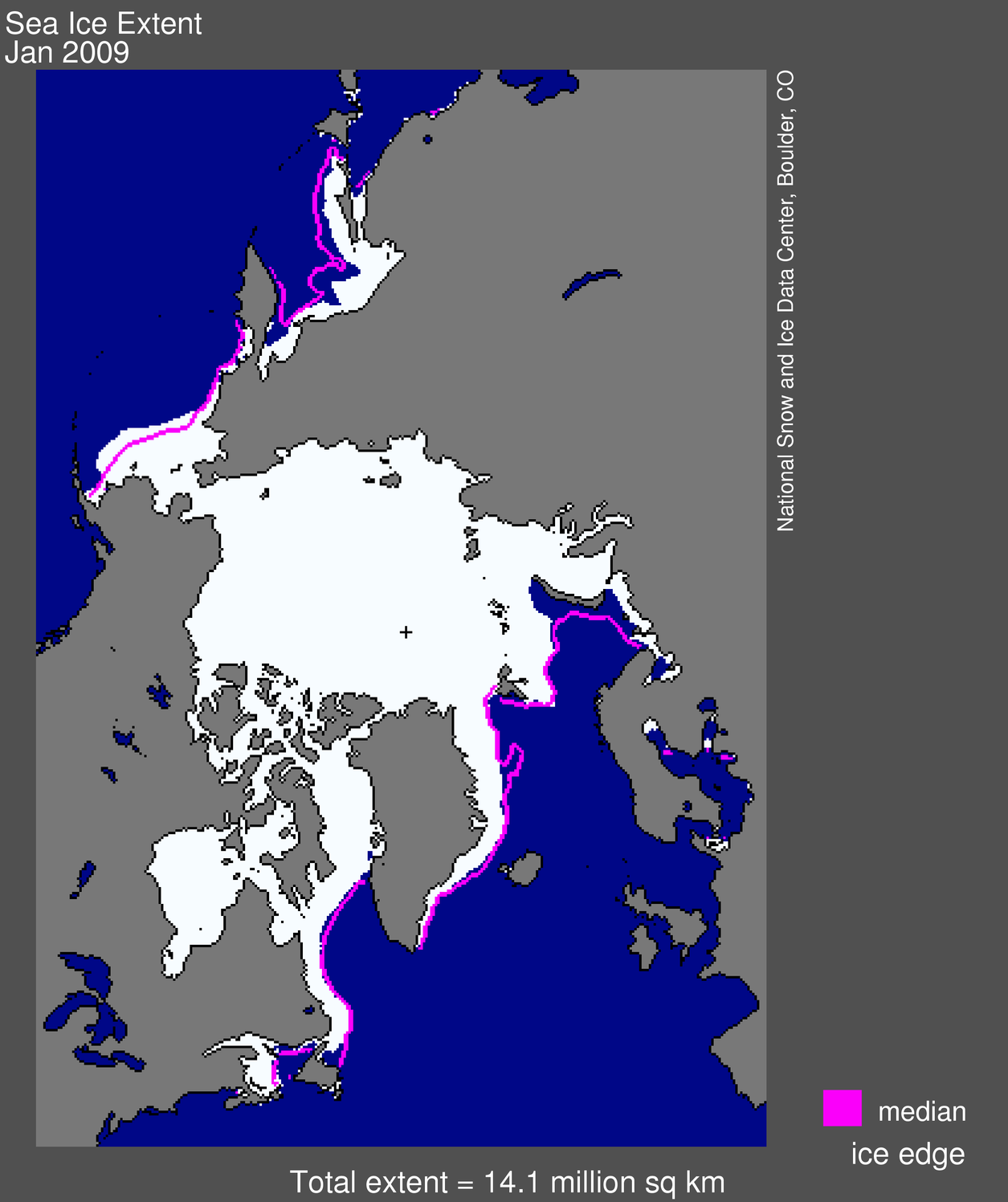
As is typical during mid-winter, sea ice extent increased overall in January; maximum monthly extent is expected in March. However, January ice extent remained well below normal compared to the long-term record. Ice extent averaged for January 2009 is the sixth lowest January in the satellite record. Also of note is that from January 15 to 26, ice extent saw essentially no increase; an unusual wind pattern appears to have been the cause.

Map of sea ice from space, showing sea ice, continents, ocean
Figure 1. Arctic sea ice extent for January 2009 was 14.08 million km² (5.43 million miles²). The magenta line shows the 19792000 median extent for January. The black cross indicates the geographic North Pole. Sea Ice Index data. About the data.
—Credit: National Snow and Ice Data Center

High-resolution image

Overview of conditions

Arctic ice extent averaged for the month of January was 14.08 million km² (5.43 million square miles). January extent was 760,000 km² (293,000 miles²) less than for the 1979 to 2000 average, and 310,000 km² (120,000 miles²) greater than for January 2007.

During the month of January, Arctic sea ice extent increased by 1.12 million km² (440,000 miles²), an average increase of 36,000 km² (13,900 miles²) per day.

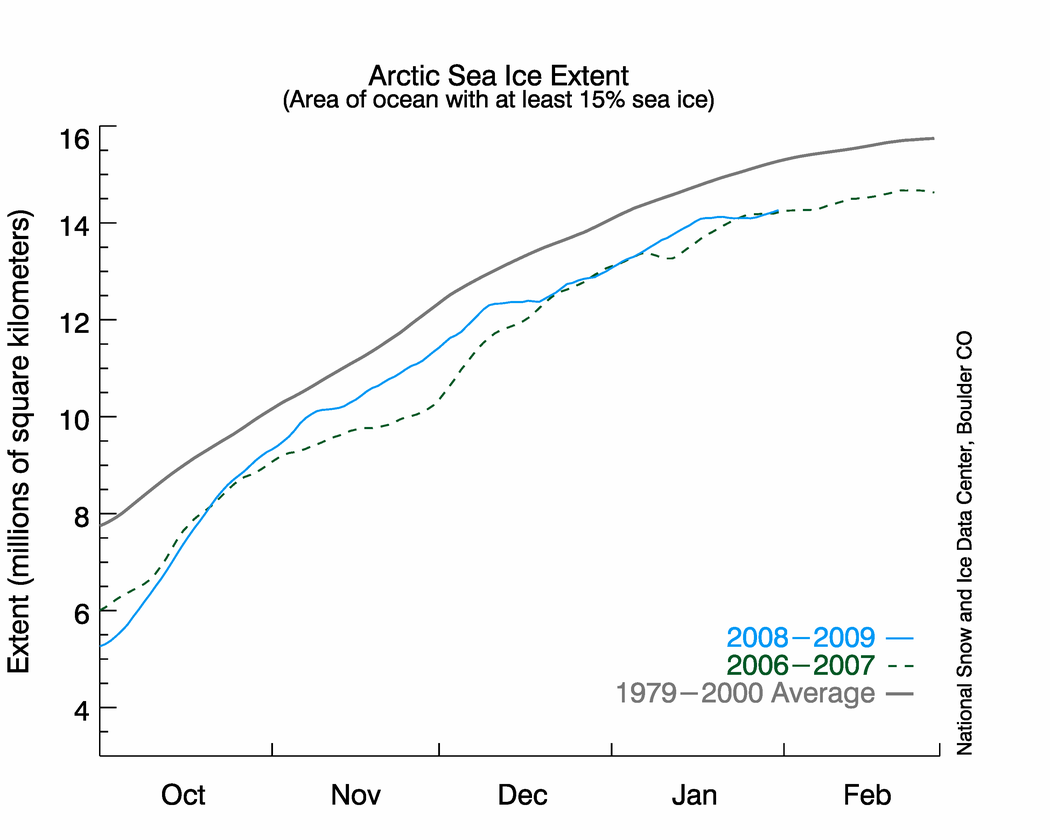
Graph with months on x axis and extent on y axisFigure 2. The graph above shows daily sea ice extent.The solid blue line indicates 2008–2009; the dashed green line shows 2006–2007 (the record-low, summer minimum occurred in 2007); and the solid gray line indicates average extent from 1979 to 2000. Sea Ice Index data. —Credit: National Snow and Ice Data Center

High-resolution image

Conditions in context

While ice extent climbed through the month of January as a whole, the period from January 15 to 26 saw almost no increase in ice extent, appearing as a flattening in the line graph. Extent during this pause remained fairly steady at around 14.0 million square kilometers (5.4 million square miles).

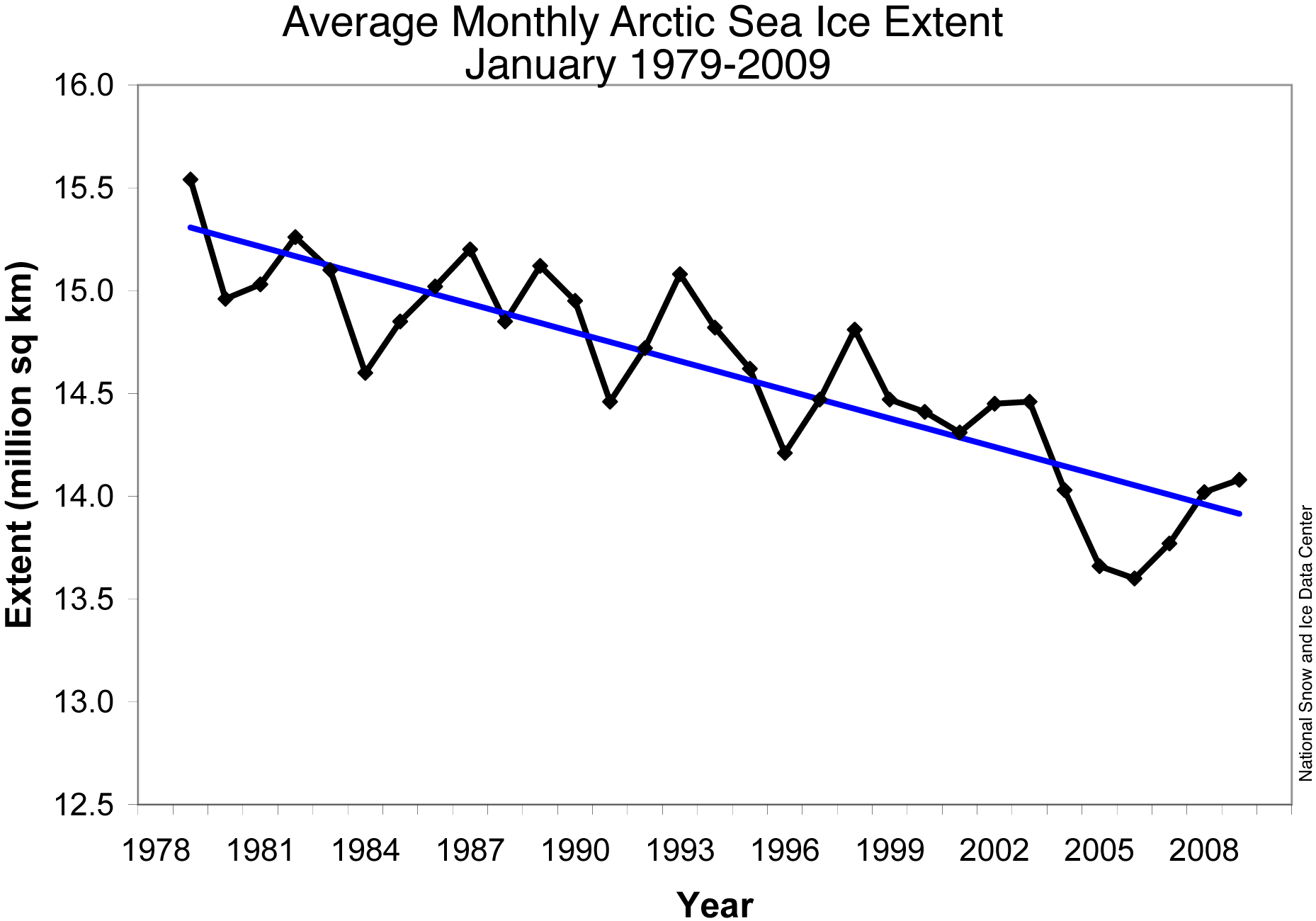
chart showing january extentFigure 3. Monthly January ice extent for 19792009 shows 2009 as the sixth lowest January on record. —Credit: National Snow and Ice Data Center
High-resolution image

January 2009 average extent compared to past Januaries

Average ice extent for January 2009 was the sixth lowest in the satellite record. January 2006 had the lowest ice extent for the month; January 2005 claims second place; and January 2007 is in third place. Including 2009, the downward linear trend in January ice extent stands at 3.1% per decade.

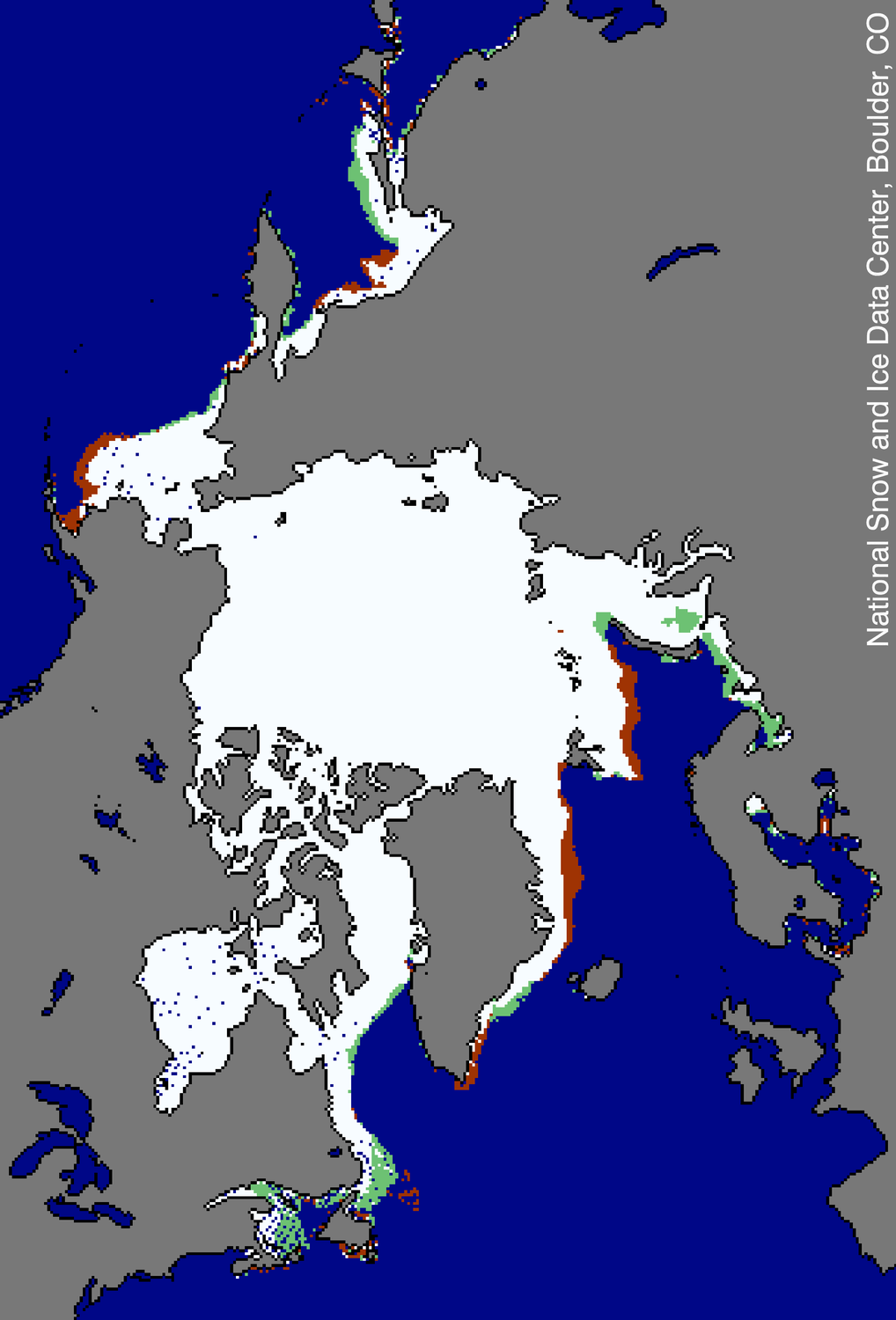
Map showing arctic air temperature anomolies in bright colors Figure 4. This map compares ice extent on January 15 to ice extent on January 26, 2009. Areas in red indicate where ice was present on January 15 but had disappeared by January 26; areas in green indicate where ice was not present on January 15 but had appeared by January 26. Note in particular the regional balance between reduced ice extent in parts of the Arctic and increased extent in others. Sea Ice Index data. —Credit: National Snow and Ice Data Center

High-resolution image

A balancing act of regional growth and decline

The pause in total sea ice extent change from January 15 to 26 reflects expanding and declining ice extent in different areas of the Arctic. For example, ice extent increased southwest of Greenland but decreased in areas east of Greenland and in parts of the Barents Sea.

This regional variability of sea ice extent as seen from satellites gives the bird's-eye view of the changeable conditions on the ground that Arctic residents must deal with. One Arctic community may note increased sea ice extent, while at the same time another community not far away may note decreased sea ice extent.

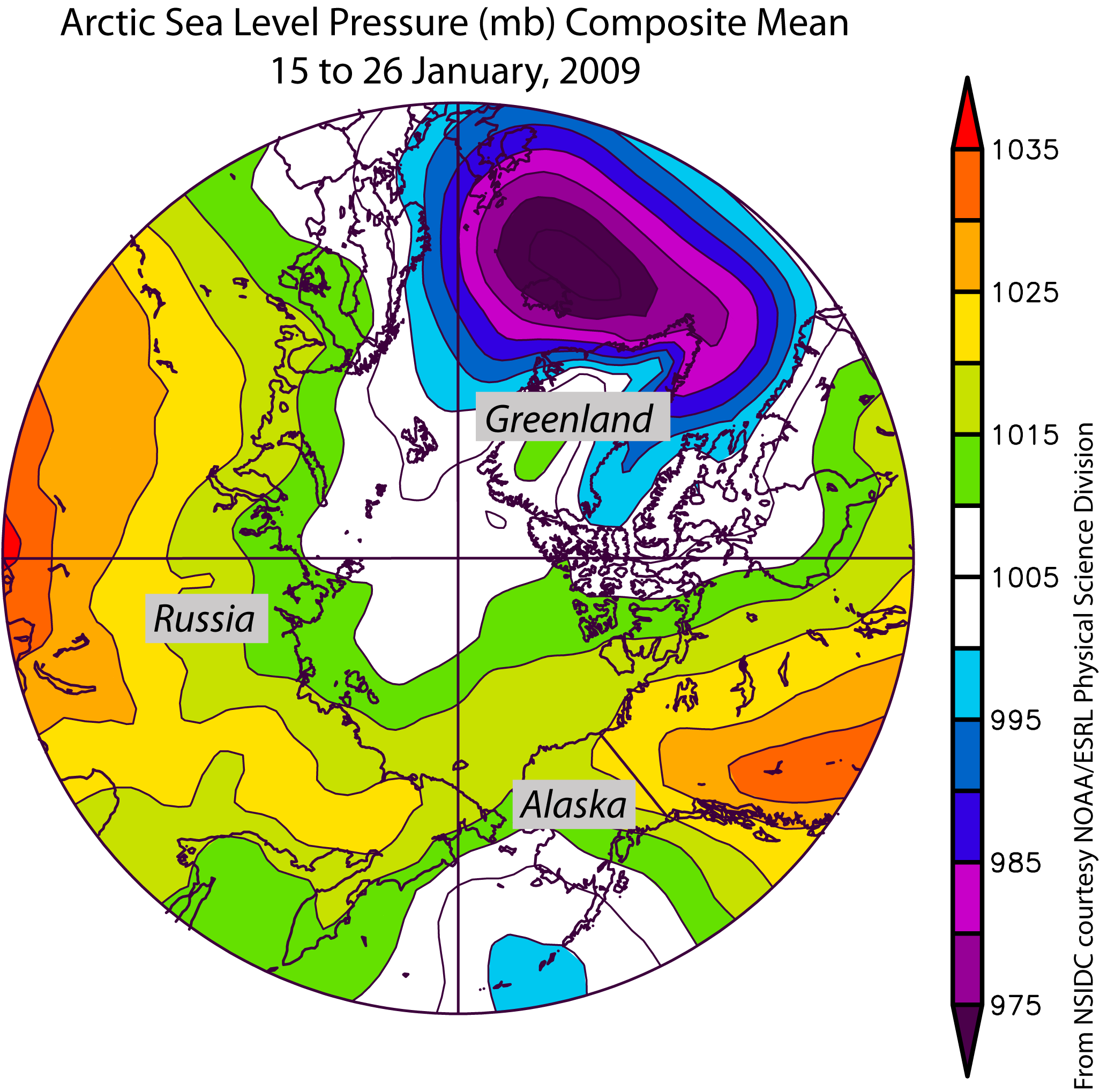
Chart showing year-long extent lines for 1979-2000 average, 2007, and 2008Figure 5. The map of sea level pressure (in millibars) averaged over the Arctic for the period January 1526, 2009, reveals one of the reasons for the pause in ice extent change—the strong low-pressure feature (blue and purple) centered just south of Iceland. Credit: From National Snow and Ice Data Center courtesy NOAA/ESRL Physical Sciences Laboratory

High-resolution image

The reason for the pause in January average ice extent change

The pause in ice extent change from January 15 to 26 is somewhat similar to an event that characterized part of December 2008. Both times, the cause for the pause was an unusual pattern of atmospheric circulation.

January 1526 saw very strong low pressure centered just south of Iceland—a very strong Icelandic Low . In accord with Buys Ballot's Law, strong warm winds from the south and southeast encouraged ice decline in areas east of Greenland and in parts of the Barents Sea area. The winds helped compact the ice cover and reduce ice growth. Regional winds from the north explain the increases in ice extent southwest of Greenland.

This strong Icelandic Low was present at the same time that atmospheric pressures were especially high over the subtropical North Atlantic. This large-scale pattern of atmospheric pressure and the regional pattern of changes in ice extent on the Atlantic side of the Arctic are classic signals of the positive phase of the North Atlantic Oscillation (NAO). The negative phase would have a weaker Icelandic Low, and roughly the inverse pattern of sea ice extent anomalies (the red and green in Figure 4 would be approximately reversed). The NAO has climate impacts not just in the Arctic, but in North America and Europe as well.

References

Rigor, I. G., J. M. Wallace, and R. L. Colony. 2002. Response of sea ice to the Arctic Oscillation. AMS Journal of Climate, Vol. 15(18), 2648–2663.

For previous analysis, please see the drop-down menu under Archives in the right navigation at the top of this page.

Link to this page (the content on this page will change as it is updated periodically): http://www.nsidc.org/arcticseaicenews/